Most people don't know it... but Bellsouth is home to the most experienced hurricane response team in the world. Bar none. Bellsouth - and pretty much any utility company in the south - has almost yearly experience recovering from some sort of natural disaster. They have successfully recovered from hurricane after hurricane, tornados, flooding, ice, etc.
After Katrina, it’s amazing that Bill Smith, Chief Technology Officer for BellSouth Corporation, and his team have yet to be guaranteed their positions once the SBC(ATT)/BellSouth merger completes. While Bill would be the first to tell you they have procedures that need improvement, the BellSouth response to Katrina and Rita's large scale crisis was professional and (relatively) effective.
Keep in mind that disaster preparedness is not revenue generating! And even in the best cases recovering from a distaster costs the company millions to billions of unbudgeted dollars. So we all need to remind the folks planning ATT/SBC/Bellsouth's 10,000 layoffs how crucial protecting these skills are.
The FCC Commissioners recently introduced a new Public Safety and Homeland Security Bureau. The new bureau will presumably continue the often complimented job (yeah, it's ok to laugh) of the FCC getting regulations out of the way during Katrina crisis. Regardless, D.C. bureaus and committees are not enough. Real public safety requires the most skilled professionals at the companies involved.
Hopefully part of the merger approval negotiations that are ongoing will include a quiet conversation between the FCC Chairman, Randall and Ed. A simple comment that the commission will continue to watch the staffing and level of investment in disaster preparedness should do the trick. AT&T has plenty of good reasons to take advantage of the BellSouth engineering talent. Let's hope they actually do the right thing.
Friday, October 13, 2006
CircuitCity.com coupon: 10% off $199 or more
Get a jump on Christmas electronics shopping! CircuitCity.com offers dealnews readers 10% off most orders of $199 or more via the link in this post. The discount shows on the page where you enter your credit card information. It matches the best percent-off discount we've seen from CircuitCity.com this year. Excludes all Apple items and iPods, all PCs, and several name brands. Coupon ends October 14.


Thursday, September 28, 2006
The true cost of residential fiber deployment
Fios Spending: $9,650 for Each Home?
Light Reading editor Phil Harvey e-mailed BroadbandReports to let them know he's crunched some numbers based on Verizon's Fios statements (discussed in full this morning), and has come to some interesting conclusions. According to Harvey, it's costing Verizon over $9,000 to wire each home (at least at first), with his math worked out as such:
He notes that Millennium Marketing analyst Kermit Ross came to some similar figures last week. Despite this, Verizon this morning stated they should see profitability by sometime in 2009.
Light Reading editor Phil Harvey e-mailed BroadbandReports to let them know he's crunched some numbers based on Verizon's Fios statements (discussed in full this morning), and has come to some interesting conclusions. According to Harvey, it's costing Verizon over $9,000 to wire each home (at least at first), with his math worked out as such:
"Verizon also says it will cost only about $650 to connect a "passed" home to its network by 2010. So what does it cost to hook up a neighborhood? These aren't absolute figures, mind you, but let's assume that Verizon passes each home in a 400-home neighborhood, then nabs 10 percent of the homes (40 homes) as customers. Take $950 and multiply it by 400 homes. That's $360,000.
Now let's hook up those 40 homes. That's 40 multiplied by $650. That's $26,000 added back to the cost to pass the homes, which was $360,000. So now we have a figure of $386,000 spent in just one neighborhood. But what has Verizon spent per customer? Take $386,000 and divide it by the 40 homes and you get $9,650."
He notes that Millennium Marketing analyst Kermit Ross came to some similar figures last week. Despite this, Verizon this morning stated they should see profitability by sometime in 2009.
Monday, September 25, 2006
Three month's til Christmas
Yep... Today is September 25th... that means it's offically 3 months til Christmas. Consider this your 90 day warning!
Sunday, September 24, 2006
Sunday, September 17, 2006
Only in California can they be so intolerant in their tolerance
There's a little PBS station in Orange County, California --KOCE. For years it has been run by the Orange Coast Community College District, but the expenses became too great, and the Trustees of the District resolved to sell it. Bids arrived, and a religious broadcaster, Daystar, bid far and away the most money.
The Trustees chose to accept a significantly smaller bid (*millions* smaller), and that one mostly paper, not cash. Daystar was offering all CASH. But the bid that was accepted was Seller Financing for 30 years w/ NO INTEREST! Not surprisingly, the California courts overturned the ridiculous deal - not once, but twice.
So did the Trustees do the right thing and gain the most cash for the district? No, they tromped off to the Sacramento based legislature to get special legislation allowing them to sell the station for far less than it was worth to their pals. Read More.Now I'm a self-acknowledged rabid Dem... but a charismatic conservative liberal instead of a faithless radical liberal. In this case I thank God that not a single Republican voted for the legislation. It was carried solely by the Democrats.
Can someone PLEASE buy them a clue about religious intolerance? And remind them about the principles of separation of church and state. That principle cuts both ways... the state can't promote a certain religion... it also can't demote/stand against a certain one either! It will come back to bite them in the butt when they need ministers to perform civil union ceremonies! Would they have made the same choice if a Muslim Emon had been the highest bidder?
Friday, September 15, 2006
Rosie was historically accurate
ABC,
Since the American Family Association is being trite with their campaign and apparently didn't study history, let me fill you in on some history. Radical Christianity WAS responsible for more murders than all the non-Christian, Muslim, etc. groups we have today put together. Here are 3 examples:
Remember that thing called the "crusades"? The Christian church from 1095 AD to 1300 AD killed anyone they could get their hands on who didn't bow down the Pope.
Remember that guy named Hitler? He wanted to wipe out anyone who didn't fit his particular mold of radical Christianity called "Positive Christianity" which included a Jesus who was recast as a killer of the Jews.
Remember that guy named Moses? During the trip out of Egypt into the promised land (in Exodus), after the incident with the Golden Calf, he told the men in the group who were Levites "27 Then he said to them, "This is what the LORD, the God of Israel, says: 'Each man strap a sword to his side. Go back and forth through the camp from one end to the other, each killing his brother and friend and neighbor.' " 28 The Levites did as Moses commanded, and that day about three thousand of the people died. Exodus 27-28. 3000 of Moses own brothers and sisters died that day!
Take a little time to learn history before you reprimand someone for their comments. Lessons not learned are repeated until comprehension - including the lesson of following the uninformed leader of some right wing conservative group off the face of cliff like a lemming b/c you didn't bother to educate yourself.
Even though I don't like Rosie's personal life choices and her severe liberalism, she IS historically correct in her statement. To complain about it indicates not only historical ignorance but also a lack of American pride. America is a place where we ALL are supposed to be able to express ourselves - whether the person sitting beside you - in your opinion - is right or wrong.
Since the American Family Association is being trite with their campaign and apparently didn't study history, let me fill you in on some history. Radical Christianity WAS responsible for more murders than all the non-Christian, Muslim, etc. groups we have today put together. Here are 3 examples:
Remember that thing called the "crusades"? The Christian church from 1095 AD to 1300 AD killed anyone they could get their hands on who didn't bow down the Pope.
Remember that guy named Hitler? He wanted to wipe out anyone who didn't fit his particular mold of radical Christianity called "Positive Christianity" which included a Jesus who was recast as a killer of the Jews.
Remember that guy named Moses? During the trip out of Egypt into the promised land (in Exodus), after the incident with the Golden Calf, he told the men in the group who were Levites "27 Then he said to them, "This is what the LORD, the God of Israel, says: 'Each man strap a sword to his side. Go back and forth through the camp from one end to the other, each killing his brother and friend and neighbor.' " 28 The Levites did as Moses commanded, and that day about three thousand of the people died. Exodus 27-28. 3000 of Moses own brothers and sisters died that day!
Take a little time to learn history before you reprimand someone for their comments. Lessons not learned are repeated until comprehension - including the lesson of following the uninformed leader of some right wing conservative group off the face of cliff like a lemming b/c you didn't bother to educate yourself.
Even though I don't like Rosie's personal life choices and her severe liberalism, she IS historically correct in her statement. To complain about it indicates not only historical ignorance but also a lack of American pride. America is a place where we ALL are supposed to be able to express ourselves - whether the person sitting beside you - in your opinion - is right or wrong.
--
Blessings,
DP

- - - - - - - - - - - - - - - - - - - - - - - -

Charles Schwab, the dyslexic who parlayed his discount
brokerage firm into a personal net worth of over
$3 billion, gives this advice to those who share his
disability: "Find out what you can do well, focus on
it and work double hard." Smart words for anyone in
the workplace -- dyslexic or not.
Wednesday, September 13, 2006
Dyslexia in the Workplace
Get the Tools and Support You Need
As youngsters, Thomas Edison, Ted Turner and Charles Schwab felt frustrated. They had difficulty deciphering letters and numbers, and were labeled "stupid." Of course, they were bright enough to invent the light bulb, revolutionize television news and found a groundbreaking brokerage firm. Today, we know their problem was dyslexia, not stupidity.
As youngsters, Thomas Edison, Ted Turner and Charles Schwab felt frustrated. They had difficulty deciphering letters and numbers, and were labeled "stupid." Of course, they were bright enough to invent the light bulb, revolutionize television news and found a groundbreaking brokerage firm. Today, we know their problem was dyslexia, not stupidity.
Today's Edisons, Turners and Schwabs are being identified early with the disorder, which includes problems reading and writing, and poor short-term memory for sequences. Specialists provide coping mechanisms, and dyslexics -- whose learning differences vary from slight to severe -- receive support throughout the educational process. But what happens when they move into the workplace?
"For anyone who wants to be successful, dyslexia is definitely an obstacle," says Debra Brooks, a dyslexic who graduated from Columbia University and now works as a consultant on dyslexia in the workplace. "You have to find ways to do what successful people do."
The first step is "accepting that you'll work differently than most people," says Brooks. She recently fielded a call from an engineer who, despite hours of study, had failed a test to advance in his company three times. He wanted to learn how to pass the test, but Brooks told him not to take it the same way again. Instead, she advised him to ask to take it orally or write a paper on the subject. Both accommodations are valid under the Americans with Disabilities Act, she says.
Similarly, the Dyslexic Reader suggests requesting that instructions for tasks be provided orally, either in person, on tape, via voicemail or through a computerized voice synthesizer. Alternatively, because many dyslexics read a computer screen more easily than paper, instructions can be emailed, rather than written down.
Dyslexics often find it difficult to fill out forms. The Reader's answer: Dyslexics can answer questions orally or dictate their responses to a colleague who can fill out the form for them.
Dyslexia-Adults.com offers other suggestions. Dyslexics should break large tasks into small, manageable chunks. The verbal and aural reinforcement of a small tape recorder or dictating machine can help you remember what needs to be done. Additionally, dyslexics should keep a "jobs to-do list" close at hand. They should cross off each task as it's accomplished, and check the list often.
Voice recognition software is improving rapidly. Speaking into a computer is a great boon for dyslexics, whose fear of writing may become paralyzing.
Spell-checkers also help. Programs like Texthelp can help with recalling words that dyslexics frequently misspell and add them to lists for auto-correction. A reading pen (available from dyslexic.com) can be run over a word that's difficult to decipher. The pen "says" the word out loud or through a small earpiece -- it does not speak entire sentences, however.
Low-tech solutions work too. Examples include highlighters for keywords or rulers to separate lines of figures.
Dyslexia-Adults.com suggests tackling paperwork early in the day. Fatigue adversely affects dyslexics' ability to read, spell and work with numbers. Also helpful: Take short breaks throughout the workday to refresh concentration.
From the time of diagnosis, dyslexics should "learn what you can and can't do," says Brooks. "Be honest and upfront with the people you work with. Let them know you work differently -- but you work hard." In fact, she adds, employers and colleagues soon learn that dyslexics are intensely loyal. "We work like dogs."
"These are not ways of hiding behind dyslexia, or making life hard for coworkers," Brooks notes. "The work standards are the same. Dyslexics are just changing the way they meet them."
Schwab, the dyslexic who parlayed his discount brokerage firm into a personal net worth of over $3 billion, gives this advice to those who share his disability: "Find out what you can do well, focus on it and work double hard." Smart words for anyone in the workplace -- dyslexic or not.
The Best Time to Buy Everything
By Kelli B. Grant
September 5, 2006 When to buy: On a Wednesday, 21 days (or a couple of days earlier) before your flight. Why: Airlines make major pricing changes (and run fare sales) every week, typically on Tuesday evenings and Wednesday mornings. About 21 days out from your flight, you'll see plenty of deals out there as airlines scramble to fill seats. Don't wait much longer, she cautions; prices jump significantly from 14 to seven days ahead of departure.
Appliances
When to buy: During a holiday weekend. Why: You'll find sales on select models all year long, but retailers bring out the big guns for holiday weekends, says Carolyn Forte, homecare director for the Good Housekeeping Institute. But don't worry about spending your Fourth of July and Labor Day weekends shopping for a new fridge — smaller holidays like Columbus Day and President's Day have their share of sales, too.
Baby Clothes
When to buy: During your pregnancy. Why: Once you know your due date, keep an eye out for end-of-season clearances, recommends Alan Fields, co-author of "Baby Bargains." "If you're [newly] pregnant now, you know you'll be having a baby next summer," he says. "Well, right now, stores are closing out all the summer clothes." You can pick up newborn essentials like onesies for less than half price. (For more ways to save, see our column Oh Baby!1)
Broadway Tickets
When to buy: Hours before the curtain rises. Why: How does a $25 front-row seat to the smash musical "Wicked" sound? Several musicals offer same-day ticket lotteries that offer up orchestra seats at inexpensive prices. If you'd rather not gamble on getting a seat, wait in line at the famous TKTS booth2 in Times Square. There, you can get tickets for hit musicals for up to 50% off. On a recent night, prime seats were available for "Hairspray," "Rent," "Sweeney Todd" and "Beauty & the Beast." (For the right times to drop by TKTS, and other ways to save, see our column A Midsummer Night's Dream3.)
Cars
When to buy: Weekday mornings in September. Why: By September, all the next year's models have arrived at the lot, and dealers are desperate to get rid of the current year's leftovers, says Phil Reed, consumer advice editor for Edmunds.com. It's the prime time of year for incentives and sales, not to mention bargaining. "Any car that's been on the lot for a long time loses its value in the eyes of the car salesman," he says.
Champagne
When to buy: December Why: Most people assume that because everyone wants a good bottle of Champagne for New Year's Eve that prices go up during the holidays, says Sharon Castillo, director of the Office of Champagne, USA, which represents the trade association of growers in the Champagne region. But due to fierce competition among the Champagne houses, prices are actually lower during the holidays than they are at any other time of year. (For more on picking the right bottle, see our column Break Out the Bubbly5.)
Clothing
When to buy: Thursday evenings, six to eight weeks after an item arrives in stores. Why: After an item lingers in stores a month or more, retailers start dropping its price to get it out the door, says Kathryn Finney, author of "How to Be a Budget Fashionista." These season-end clearances tend to be the same month that designers host fashion weeks (February and September) to preview the next fall or spring collections. So smart buyers can check the catwalk to see if any of this season's trends — say, leggings or military-style jackets — will still be hot next year, and then scoop them up on clearance.
Computers and electronics
When to buy: Just after a new model is launched. Why: When the latest and greatest of a product is released, you'll often see prices drop on what had previously been the best thing out there, says Tom Merritt, executive editor for CNET, an electronics review web site. Case in point: When Apple released the Nano last September, prices for the now-discontinued Mini dropped 12%, from $199 for a 4GB to about $175. So keep your eyes open for announcements from major manufacturers. Want a little less work? Time your purchases for after big annual technology show like MacWorld6 (next held Jan. 8-12, 2007) and the International Consumer Electronics Show7 (next held Jan. 8-11, 2007).
Gas
When to buy: Early morning or late evening on a weekday. Why: Time your trip based on whether prices are rising or falling, advises Marshall Brain, founder of HowStuffWorks8, a consumer guide. Gas stations tend to change their prices between 10 a.m. and noon, so hit the pump in the early morning if gas prices are on the rise. Go later in the day if prices are falling. Tipsters on GasPriceWatch.com reported that on Sept. 3, a WaWa gas station in Lanoka Harbor, N.J., was offering regular gas for $2.85 a gallon. One day later the station's price had dropped to $2.65. In that case, going early would have cost you 20 cents more per gallon.
Gift Cards
When to buy: A day or two before you give it. Why: These days, gift cards carry a plethora of hidden pitfalls, from expiration dates to dormancy fees, says Dan Horne, a professor of marketing at Providence College known as the "Gift Card Guru." That countdown to fees starts as soon as you buy the card. "You don't want to short-change the recipient," he says.
Groceries
When to buy: Sunday evenings. Why: Store sales tend to run Wednesday through Tuesday, says Teri Gault, founder of The Grocery Game10, a consumer savings program. On Sunday, you'll also have the latest round of manufacturer's coupons from your morning paper. "You can maximize your coupons available for that shopping week," she says. Heading to the store close to closing time means you'll have access to sales on fresh items that must be sold by the end of the day, such as meats and baked goods.
Shrubs, Trees and Other Plants
When to buy: Fall Why: Take a break from raking up leaves to purchase trees, shrubs and other perennials for your yard. Prices nosedive after midsummer, as garden supply stores and nurseries try to clear out their stock. You can also get great deals on bulbs during the fall. Just store them according to the package instructions for best planting results next spring. For more, see our column Cheap Landscaping Tricks11.)
Televisions
When to buy: Six to 12 months after a particular model is launched. Why: A new TV drops in price after a few months on the market, says CNET's Merritt. Although there will be newer models out there, it's unlikely they'll offer any significant improvements to justify that brand new price. "The technology is proceeding at such a pace that the models out there are not going to be obsolete anytime soon," he says. (For more, see our column The World Is Flat12.)
Wedding Dresses
When to buy: Between Thanksgiving and Christmas. Why: Boutiques are stocked up on dresses for the post-Christmas rush (many people get engaged over the holidays), yet traffic is low, says Fields, who also co-authored "Bridal Bargains." "It's not a busy time to buy a wedding dress because people are thinking about the holidays," he says. You'll also have room to bargain.
Wine
When to buy: Early fall. Why: For best selection, you can't beat the fall harvest season. That's when most vineyards release their latest vintages. Buying in August and September is also your best shot at snagging so-called "cult wines" — those with limited production and high demand, says Kathleen Schumacher-Hoertkorn, CEO of New Vine Logistics, an online interstate wine retailer. (For more, see our column Buying Wine Online13.)
September 5, 2006
AT 50 CENTS a roll — instead of the regular retail price of $4 — buying wrapping paper after New Year's is an easy way to save. The same holds true for buying half-price inflatable pool loungers and patio furniture after Labor Day weekend.
In fact, bargain lovers know that there's a smart time to buy just about anything. For example, those looking for a great deal on a car should shop on weekday mornings in September. Groceries are cheapest on Sunday evenings.
We talked to the experts, and found the best time to buy everything from wine to wedding dresses.
Airplane Tickets
When to buy: On a Wednesday, 21 days (or a couple of days earlier) before your flight. Why: Airlines make major pricing changes (and run fare sales) every week, typically on Tuesday evenings and Wednesday mornings. About 21 days out from your flight, you'll see plenty of deals out there as airlines scramble to fill seats. Don't wait much longer, she cautions; prices jump significantly from 14 to seven days ahead of departure.Appliances
When to buy: During a holiday weekend. Why: You'll find sales on select models all year long, but retailers bring out the big guns for holiday weekends, says Carolyn Forte, homecare director for the Good Housekeeping Institute. But don't worry about spending your Fourth of July and Labor Day weekends shopping for a new fridge — smaller holidays like Columbus Day and President's Day have their share of sales, too.Baby Clothes
When to buy: During your pregnancy. Why: Once you know your due date, keep an eye out for end-of-season clearances, recommends Alan Fields, co-author of "Baby Bargains." "If you're [newly] pregnant now, you know you'll be having a baby next summer," he says. "Well, right now, stores are closing out all the summer clothes." You can pick up newborn essentials like onesies for less than half price. (For more ways to save, see our column Oh Baby!1)Broadway Tickets
When to buy: Hours before the curtain rises. Why: How does a $25 front-row seat to the smash musical "Wicked" sound? Several musicals offer same-day ticket lotteries that offer up orchestra seats at inexpensive prices. If you'd rather not gamble on getting a seat, wait in line at the famous TKTS booth2 in Times Square. There, you can get tickets for hit musicals for up to 50% off. On a recent night, prime seats were available for "Hairspray," "Rent," "Sweeney Todd" and "Beauty & the Beast." (For the right times to drop by TKTS, and other ways to save, see our column A Midsummer Night's Dream3.)Cars
When to buy: Weekday mornings in September. Why: By September, all the next year's models have arrived at the lot, and dealers are desperate to get rid of the current year's leftovers, says Phil Reed, consumer advice editor for Edmunds.com. It's the prime time of year for incentives and sales, not to mention bargaining. "Any car that's been on the lot for a long time loses its value in the eyes of the car salesman," he says. Heading to the dealership on a weekday morning also helps because there's low foot traffic, meaning you'll have ample time to negotiate and fewer people trying to buy the same car. The more demand, the less willing a salesman is to go down on price, says Reed. (For more, see our column Summer Car Savings4.)
Champagne
When to buy: December Why: Most people assume that because everyone wants a good bottle of Champagne for New Year's Eve that prices go up during the holidays, says Sharon Castillo, director of the Office of Champagne, USA, which represents the trade association of growers in the Champagne region. But due to fierce competition among the Champagne houses, prices are actually lower during the holidays than they are at any other time of year. (For more on picking the right bottle, see our column Break Out the Bubbly5.)Clothing
When to buy: Thursday evenings, six to eight weeks after an item arrives in stores. Why: After an item lingers in stores a month or more, retailers start dropping its price to get it out the door, says Kathryn Finney, author of "How to Be a Budget Fashionista." These season-end clearances tend to be the same month that designers host fashion weeks (February and September) to preview the next fall or spring collections. So smart buyers can check the catwalk to see if any of this season's trends — say, leggings or military-style jackets — will still be hot next year, and then scoop them up on clearance. Hitting the mall on a weekday ensures you'll get a good selection. "On the weekend, you'll only get picked-over stuff because the stores don't have time to restock," she says. By Thursday, most of the weekend sales have begun, but everything available is on the floor.
Computers and electronics
When to buy: Just after a new model is launched. Why: When the latest and greatest of a product is released, you'll often see prices drop on what had previously been the best thing out there, says Tom Merritt, executive editor for CNET, an electronics review web site. Case in point: When Apple released the Nano last September, prices for the now-discontinued Mini dropped 12%, from $199 for a 4GB to about $175. So keep your eyes open for announcements from major manufacturers. Want a little less work? Time your purchases for after big annual technology show like MacWorld6 (next held Jan. 8-12, 2007) and the International Consumer Electronics Show7 (next held Jan. 8-11, 2007). When to buy: Early morning or late evening on a weekday. Why: Time your trip based on whether prices are rising or falling, advises Marshall Brain, founder of HowStuffWorks8, a consumer guide. Gas stations tend to change their prices between 10 a.m. and noon, so hit the pump in the early morning if gas prices are on the rise. Go later in the day if prices are falling. Tipsters on GasPriceWatch.com reported that on Sept. 3, a WaWa gas station in Lanoka Harbor, N.J., was offering regular gas for $2.85 a gallon. One day later the station's price had dropped to $2.65. In that case, going early would have cost you 20 cents more per gallon. Try not to buy gas on the weekends, Brain says. Gas prices are often slightly elevated, as stations try to profit from leisure travelers. (For more ways to save, see our column Save on Gas9.)
Gift Cards
When to buy: A day or two before you give it. Why: These days, gift cards carry a plethora of hidden pitfalls, from expiration dates to dormancy fees, says Dan Horne, a professor of marketing at Providence College known as the "Gift Card Guru." That countdown to fees starts as soon as you buy the card. "You don't want to short-change the recipient," he says.Groceries
When to buy: Sunday evenings. Why: Store sales tend to run Wednesday through Tuesday, says Teri Gault, founder of The Grocery Game10, a consumer savings program. On Sunday, you'll also have the latest round of manufacturer's coupons from your morning paper. "You can maximize your coupons available for that shopping week," she says. Heading to the store close to closing time means you'll have access to sales on fresh items that must be sold by the end of the day, such as meats and baked goods. Of course, you'll also benefit from in-season items that can be frozen for use later in the year, says Gault. That means turkeys at Thanksgiving and hams at Christmas and Easter. During the spring and summer, buy fresh produce. Peaches bought at $1 per pound now can be kept frozen for smoothies and pies throughout the winter, she says.
Shrubs, Trees and Other Plants
When to buy: Fall Why: Take a break from raking up leaves to purchase trees, shrubs and other perennials for your yard. Prices nosedive after midsummer, as garden supply stores and nurseries try to clear out their stock. You can also get great deals on bulbs during the fall. Just store them according to the package instructions for best planting results next spring. For more, see our column Cheap Landscaping Tricks11.)Televisions
When to buy: Six to 12 months after a particular model is launched. Why: A new TV drops in price after a few months on the market, says CNET's Merritt. Although there will be newer models out there, it's unlikely they'll offer any significant improvements to justify that brand new price. "The technology is proceeding at such a pace that the models out there are not going to be obsolete anytime soon," he says. (For more, see our column The World Is Flat12.)Wedding Dresses
When to buy: Between Thanksgiving and Christmas. Why: Boutiques are stocked up on dresses for the post-Christmas rush (many people get engaged over the holidays), yet traffic is low, says Fields, who also co-authored "Bridal Bargains." "It's not a busy time to buy a wedding dress because people are thinking about the holidays," he says. You'll also have room to bargain.Wine
When to buy: Early fall. Why: For best selection, you can't beat the fall harvest season. That's when most vineyards release their latest vintages. Buying in August and September is also your best shot at snagging so-called "cult wines" — those with limited production and high demand, says Kathleen Schumacher-Hoertkorn, CEO of New Vine Logistics, an online interstate wine retailer. (For more, see our column Buying Wine Online13.)
Tuesday, September 05, 2006
10 Avoidable IT Interview Flubs
eWEEK rounds up some of the worst offenses, and while we're certain that none of you would ever make such obvious errors, it never hurts to review before your next interview.
Make sure you don't forget the Thank You note. I know I personally won't hire you if I don't get one!
}Davoice
Make sure you don't forget the Thank You note. I know I personally won't hire you if I don't get one!
}Davoice
Do aspects of Christianity violate the Law of Non-contradiction?
Does Christianity and its tenets violate the Law of Non-contradiction?
Use the link above to listen to the answer.
For the uninitiated, the Law of Non-contradiction states that no truth can exist when 2 central theses are in opposition to each other. How can we believe in 1 God when we are told there are "3 in 1", the Holy Trinity.
}Davoice
Use the link above to listen to the answer.
For the uninitiated, the Law of Non-contradiction states that no truth can exist when 2 central theses are in opposition to each other. How can we believe in 1 God when we are told there are "3 in 1", the Holy Trinity.
}Davoice
Sunday, September 03, 2006
Dyslexia is very annoying when...
- You're trying to absorb a 700 page technical manual and your brain keeps getting full b/c it can't keep up with the pace of the alternative reading method you were taught.
- You flip the digits of a phone number and end up calling someone you just dumped instead of the person you dumped them for.
- Someone sends you a 700 page e-book to read and you have to pay to have it printed at Staples so you can read it.
- You go to look up a new word in the dictionary... only to find out it's not a new word at all.
- You keep misspelling your own name in letters and emails... and you consistently misspell it the same way every time. (Thank goodness for Word Auto-correct.)
The Banker's Sandwich
Heard of a new sandwich today... The BB&T. Hence the nickname "the banker's sandwich".
Ingredients: Bacon, Basil & Tomato.
Serve on toasted rye bread. And if you're one of those people who actually likes mayonnaise, add a good smear.
An even funnier named variation... The BB & TP. Bacon, Basil, Tomato & Provolone. Yummy.
}Davoice
Ingredients: Bacon, Basil & Tomato.
Serve on toasted rye bread. And if you're one of those people who actually likes mayonnaise, add a good smear.
An even funnier named variation... The BB & TP. Bacon, Basil, Tomato & Provolone. Yummy.
}Davoice
Thursday, August 31, 2006
Cheap dedicated servers
I went on a quest a few weeks ago to find the most reliable cheap dedicated servers in the market for higher end applications. In the process I came up with a big handful of possibilities. Of them, I narrowed the list down to these:
- Rackspace was eliminated b/c they don't publish their pricing and I didn't like the quote I got.
- Hostgator was reasonable, but just reselling a ThePlanet server. Not a bad option though since it was cheaper than buying direct from ThePlanet.
- Pair I liked but their bandwidth packages didn't fit what I was looking for.
- ServerBeach was out of stock of the one I wanted. But their prices weren't great regardless.
So... that left me with 1&1. Which had the lowest price, was the only one offering Plesk 8, and offered double the RAM for the same money.
I'll report back on how things go later in the year.
PS... If you're looking for a VAR to help with telephone systems, routers, and VoIP equipment, check out VARNetwork.
- EV1
- Rackspace
- 1&1
- Hostgator
- Pair
- ServerBeach
- Rackspace was eliminated b/c they don't publish their pricing and I didn't like the quote I got.
- Hostgator was reasonable, but just reselling a ThePlanet server. Not a bad option though since it was cheaper than buying direct from ThePlanet.
- Pair I liked but their bandwidth packages didn't fit what I was looking for.
- ServerBeach was out of stock of the one I wanted. But their prices weren't great regardless.
So... that left me with 1&1. Which had the lowest price, was the only one offering Plesk 8, and offered double the RAM for the same money.
I'll report back on how things go later in the year.
PS... If you're looking for a VAR to help with telephone systems, routers, and VoIP equipment, check out VARNetwork.
Monday, August 28, 2006
Telcos Lobby CA: $19.7 Million in 3 Months
The push for a statewide video franchise
As California prepares to vote on whether to give the baby bells a statewide video franchise, the San Francisco Chronicle reports that Verizon & AT&T have spent a whopping $19.7 million, or $200,000 per day to influence the vote. A statewide franchise would exclude telcos from localized laws that require cable operators to build out to broad portions of communities.
"AT&T led the way by spending nearly $18 million on lobbyists; television, radio and newspaper advertising; wining and dining lawmakers at the Monterey Bay Aquarium; and Lakers basketball tickets for the chairwoman of the Senate committee that held hearings on the legislation, records show."Despite consumer group (and of course cable company) opposition to the measure, "the legislation has yet to receive a single "no" vote during committee and floor votes," the paper observes. Final votes are expected on the bill this week.
Tuesday, August 15, 2006
Joshua 1:9 (New Living Translation)
"I command you--be strong and courageous! Do not be afraid or discouraged. For the LORD your God is with you wherever you go."
Monday, August 14, 2006
Oil crisis: It's only just begun
By Paul Salopek  Marathon station manager Michelle Vargo keeps an eye on customers in South Elgin, Ill. A single mother, she has worked long hours to turn a profit in a business that actually makes tiny profits from gasoline.
Chicago Tribune
 Marathon station manager Michelle Vargo keeps an eye on customers in South Elgin, Ill. A single mother, she has worked long hours to turn a profit in a business that actually makes tiny profits from gasoline.
 Burke Transport Service driver Howard Dunbar guides his load of 7,000 gallons of fuel from a terminal in Arlington Heights, Ill., through the dark streets toward the South Elgin Marathon station.
Last summer, a gasoline station opened in South Elgin, Ill., an old farming village that's now being swallowed by the westward sprawl of Chicago.
As service stations go, it's an alpha establishment. A $3 million Marathon outlet with 24 digital pumps, a computerized car wash and a convenience store lit up like an operating room, it sells everything from ultra-low-sulfur diesel to an herbal "memory enhancer" to Krispy Kreme doughnuts.
Howard Dunbar's Tanker Truck 6 rolled into the station one night last September and proceeded to unload 7,723 gallons of gasoline and diesel into underground tanks.
This bonanza would be sucked dry by customers in 24 hours, a small, stark example of the nation's awesome petroleum appetite at a time the planet appears to be lurching into an energy crunch of historic proportions.
By now, most Americans realize that something is profoundly awry in the global oil patch.
For most motorists, like the "swipe and go" customers at the South Elgin Marathon, the evidence is painfully obvious: record-high fuel costs that have surpassed last year's infamous price spikes after Hurricane Katrina. Prices are expected to go even higher, especially in the Pacific Northwest and California, after the shutdown of an oil pipeline on Alaska's northern slope.
Yet to fully grasp the scope of the crisis looming before them, Americans must trace their seemingly ordinary tankful of gasoline back to its shadowy sources. This is, in effect, a journey into the heart of America's vast and troubled oil dependency.
"I truly think we're at one of those turning points where the future's looking so ugly nobody wants to face it," said Matthew Simmons, a Houston energy investment banker who has advised the Bush administration on oil policy. "We're not talking some temporary Arab embargo anymore. We're not talking your father's energy crisis."
What Simmons and many other experts are talking about is a bleak new collision between geology and geopolitics.
Below ground, the biggest worry is "peak oil" — the notion that the world's total petroleum endowment is approaching the half-empty mark, a geological tipping point beyond which no amount of extra pumping will revive fading oil fields.
Peak-oil theory is controversial. Many think it alarmist. Yet even Big Oil is starting to gird itself for possible fuel shortages: Chevron, the nation's second-largest oil company, has bluntly declared that "the era of easy oil is over" and is warning energy-hungry Americans that "the world consumes two barrels of oil for every barrel discovered."
Aboveground, things look little better. Most petro states, aware that crude supplies are growing increasingly valuable, have limited drilling rights to their own oil companies.
Meanwhile, thirst for petroleum continues to run wild. Producing nations are pumping at maximum capacity. Yet the competing energy demands of America and rapidly industrializing China and India now threaten to outstrip global oil output. Chinese oil imports are projected to double to 14 million barrels a day over 20 years. Many credible analysts foresee a new "energy cold war" as the United States and China square off over the planet's last reserves.
The new Marathon station in South Elgin turned out to be an ideal laboratory to parse these sobering issues. Exclusive access to industry refining data made it possible, for the first time, to track oil consumed by this one gas station back to the dusty war zones, belligerent autocracies and tottering nation-states from where it came.
For years, oil companies have insisted that this could never be done. Conventional wisdom holds that America's colossal oil flows are mixed, swapped among companies and rebranded too many times to pinpoint the actual source of your $40 purchase of unleaded.
Yet, with a little research and proprietary data supplied by Marathon Petroleum, the Chicago Tribune could trace with unparalleled clarity virtually every bucketful of trucker Howard Dunbar's shipment to its distant origins.
On the hydrocarbon menu that September night, in round figures:
• Gulf of Mexico crudes: 31 percent
• Texas crudes: 28 percent
• Nigerian crudes: 17 percent
• Arab light from Saudi Arabia: 10 percent
• Louisiana sweet: 8 percent
• Illinois Basin light: 4 percent
• Cabinda crude from Angola: 3 percent
• N'Kossa crude from the Republic of Congo: .01 percent
Thus, $73.81 worth of unleaded pumped one Saturday by a Little League mom was traced not simply back to Africa, but to a particular set of Nigerian offshore fields through which Ibibio villagers canoed home to children dying of curable diseases.
Every day, the jaded tanker drivers brought human stories echoing in their trucks. They plunked their long wooden measuring sticks into the Marathon station's 40,000-gallon underground tanks, and the resulting subterranean gong evoked — depending on the changing oil vintage — an Iraqi ex-colonel's cavernous loneliness. Or the laments of a West African fisherman named Sunday, afloat on a fishless stretch of the Atlantic. Or the songs of Marxist Indians reveling in their newfound oil wealth atop a dusty South American plateau.
The voices of Chinese oil prospectors gurgled inside all of the fuel shipments. And diluted in the gas came a warning that many Americans seem unprepared to hear: Our nation's energy-intensive joy ride, powered by 150 years of cheap petroleum, may be coming to an end.
Journey to the pump
It was September. Hurricanes Katrina and Rita had delivered their one-two punch to the energy-rich Gulf Coast, swamping New Orleans and disabling the offshore wells and pipelines that yield one-third of America's domestic energy production. In South Elgin, population 20,000, gas prices at the Marathon had broken the $3-a-gallon barrier, and people were stealing Michelle Vargo's gasoline.
"You'd think it would only be the crummy cars, but people in nice cars are doing it, too," the frazzled station manager exclaimed. "I never seen anything like it."
Vargo, 36, is too young to recall that this had happened during the Arab oil embargo of 1973 and the Iranian hostage crisis of 1979.
In typically murky industry fashion, the station is branded and supplied by Marathon but actually owned by an independent fuel retailer — in this case, Prairie State Enterprises of Barrington, Ill. Freelance shippers called "jobbers" haul the gas. And even though much of the station's petroleum does in fact bubble from Marathon's oil patches, the company as often purchases its oil from Exxon Mobil, Iraq's Southern Oil Co. or Venezuela's PDVSA, a swaggering national oil company with its own patriotic song.
A single mom with a hard-edged life, Vargo is one part in a ruthless business that earns a pittance from gasoline sales (oil companies and refiners snatch the bulk of the fuel's profits). Her station's income comes from the incidentals of frantic modern life: cigarettes, energy drinks, stay-awake pills, the Lotto, and sweet and salty snacks.
The clerks are a motley group. Many are the working poor. Some can't pay their bills. Several live with their parents.
Vargo drives to work in a car she can't afford — a white Chevrolet Suburban that churns out a ruinous 10 miles a gallon and rides so high that she has to boost herself into the driver's seat as if jumping into a saddle. Her two-hour daily commute, about 40 miles each way from Lockport, is roughly double the national average.
"I don't feel safe in small cars," Vargo said defensively.
The only perk for the station employees is free coffee. There are no discounts on gas.
From the ocean's floor
In 1940, the United States was the Saudi Arabia of the world. It produced 63 percent of the planet's oil. Today, it generates 8 percent.
About one-third of Vargo's fill-up on a recent day came from the last major pool of crude remaining in oil-starved America: the basement of the Gulf of Mexico. Trace it from seabed to suburbia, and you X-ray America's aging industrial innards.
It started 9,000 feet inside Earth's crust, in Miocene Epoch rocks that have the consistency of oil-soaked beach sand. The rocks simmer near the boiling point of water. This is known in the business as the "pay zone."
From that hellish place, the crude was sucked up into a 4-inch drill pipe that punctured the Atlantic floor near a submerged hillock called Viosca Knoll 786. It shot up 1,750 feet of pipe to an offshore production rig and was shunted ashore to a huge tank farm in St. James, La. There it began its long journey to the Midwest in a pipeline big enough for a person to walk in, albeit hunched over — a 632-mile-long artifact of our oil dependency that will doubtless astound future archeologists.
Arriving at the Robinson refinery in southern Illinois, it was cooked and cooled for five days inside 23-story towers. Then it gushed through 16- and 12-inch fuel pipelines for three days until it reached a 40-year-old tank farm near O'Hare International Airport. Finally, it traveled its last 12 miles to the South Elgin Marathon inside Howard Dunbar's truck.
"Takes a bit of power to bring it up," hollered Ferrell Martin, 52, a senior mechanic aboard Petronius, a drilling platform that juts above the gulf's waves near Viosca Knoll. "Our generators could electrify a small town."
The platform, co-owned by Chevron and Marathon, came on line in 2000. It cost more than $500 million to build, nearly what the United States shells out every 24 hours to buy imported crude. A masterpiece of high technology, it pumps the energy equivalent of 60,000 barrels of oil and natural gas a day — a gusher that matches Pakistan's national output and is only slightly behind Italy's.
More than 100 such gargantuan structures dot the gulf. As do an estimated 6,500 other oil-related features such as wells, pumping stations and helipads, not to mention some 30,000 miles of submerged pipelines tangled like spaghetti across the gulf floor.
"A whole new game"
One man who keeps Michelle Vargo's gas-guzzling Suburban rolling doesn't have an oil worker's rough hands. He sits in a red granite skyscraper in Houston.
"No question, we're facing a whole new game," said Jeff Rutledge, a sandy-haired New Orleans native and the senior geophysicist for Marathon. "Sure, there's a lot of resources still out there, but they're getting riskier to invest in, much harder to find and more expensive to reach."
At Marathon's technology and exploration department, desks are piled with what look like old eight-track tapes: computer drives that contain volumes of exploration data that beggar belief. Seismic surveys, the industry's main tool for locating oil, involve setting off small shock waves at Earth's surface and recording millions of "echoes" from the rock below.
Progress reports from 10 to 20 of these fantastically pricey, high-tech quests from Africa, Russia and the North Atlantic land on Rutledge's desk every day.
According to industry optimists, such Herculean efforts to squeeze out Earth's last high-quality oil are the best retort to doomsayers who worry the world is running on empty.
In the gulf, for instance, Petronius' 19 wells do things engineers couldn't dream of a quarter-century ago. They snake downward through almost 1,800 feet of seawater, bore vertically through a mile and a half of rock, then veer off laterally under the stony seabed for distances of up to five miles.
Such whiz-bang technology has encouraged the U.S. Minerals Management Service to boost the Gulf of Mexico's potential oil reserves by 15 percent, to 86 billion barrels. That's enough, in theory, to meet U.S. demand for another decade. Much of that, however, lies in deep, environmentally sensitive waters near the Florida coast and is prohibitively expensive to extract using current technology.
Many oil executives say environmental restrictions and stingy foreign governments keep valuable reserves locked up.
The United States gulps one-quarter of the crude pumped on the planet, industry critics point out, yet it sits atop just 3 percent of the globe's reserves.
"You can drill in the Arctic National Wildlife Refuge, on every continental shelf and atop every hill in America for that matter, and you still won't reverse the fact that our oil production is in permanent decline," said Rep. Roscoe Bartlett, R-Md., a senior member of the House Science Committee. "We're just sopping up what's left, digging ourselves into a deeper hole."
Bartlett belongs to a small but suddenly influential band of pessimists who are ringing alarm bells over peak oil.
The perilous "peak"
The theory of peak oil is based on the studies of M. King Hubbert, a pioneering U.S. geologist who correctly predicted in the 1950s that America's huge crude output would "peak," or hit a ceiling, in 1970.
Nobody disputes that oil will peak; the debate is over when. The output of all reservoirs begins to decline after about half of their oil is extracted. Today, peakists cite anemic oil discoveries since the 1980s, plus ominous drop-offs in production in major fields in Kuwait, China and Mexico, among other places, as evidence that the world, too, is reaching its fateful peak.
Estimates of when we will hit this milestone vary from "we've passed it already" to the U.S. Geological Survey's latest calculation of 2044 — hardly a reassuring date, given that rocketing oil prices and their attendant social chaos would stagger the industrial world well before that reckoning.
Using available technology, Rutledge said, Petronius' bounty likely will shrivel in 12 to 15 years.
"Just sinking away"
Ferrell Martin's ancestors had fished and trapped the watery maze of Bayou Terrebonne, a fabled swamp about 60 miles southwest of New Orleans, for more than 200 years. But today, Louisiana's lush wetlands, the richest in America, are dying, crumbling into the sea.
Home from his usual two-week shift aboard Petronius, Martin knelt at the bow of a bass boat steered by one of his numberless bayou relatives, trying, again and again, to get the boat unstuck from hidden bars of mud.
"I can't even find the same fishing holes anymore," Martin said, fanning away mosquitoes. "The whole place is just sinking away."
The U.S. Geological Survey thinks land in and around Bayou Terrebonne is starting to sag like a deflating wineskin as fossil fuels are pumped out in massive quantities. In some places, it has settled 11 inches. For a landscape that is in many cases only a few feet above sea level, the implications are ominous. Erosion and subsidence have eaten away at least two miles of coastline near Ferrell Martin's modest house in Montegut, La.
He recognized the irony: Oil has yanked thousands of once-impoverished Cajuns into the middle class, but it is now helping swallow their ancestral homes.
"Everything's a trade-off, I guess," Martin said.
This, too, gets burned up by the cars in South Elgin: a clod of southern Louisiana.
Monday, July 24, 2006
Positive Aspects of Dyslexia
* Dyslectics are often able to understand complex ideas and have a good overview.
* They can often see several aspects of a problem at the same time.
* They usually have a good spatial awareness and can see three dimensional objects from every direction, without moving themselves.
* They can use the potential of the brain to change their perceptions and to create new possibilities.
* They are extremely aware of their surroundings and have sharp visual and analytic capabilities.
* They are more curious than the average person.
* They think mainly in images instead of words.
* Their thought processing and perception is multidimensional as they use all their senses.
* They can experience their inner world as reality with their strong imaginative power.
As a dyslexic, I have experienced many of those aspects personally. The most profound positive for me is the ability to perceive and process in multiple dimensions at once. This one skill makes dyslexics who have been taught to visually process written language (i.e. through NLP) such good knowledge acquisition specialists. (It's also why we run circles around everyone else during brainstorming sessions.)
Saturday, July 22, 2006
Ever Wonder?
Why is bottled lemon juice made with artificial flavor when dishwashing liquid is "made with real lemons"?
Why don't you ever see the headline "Psychic Wins Lottery"?
Why do we have drive-up ATM machines with Braille lettering?
Why isn't there mouse-flavored cat food?
Why didn't Noah swat those two mosquitoes?
Why do they sterilize the needle for lethal injections?
Why don't they make the whole planes out of the same stuff they make those indestructible "black box" units out of?
Why are they called apartments when they are all stuck together?
Why do drugstores make the sick walk all the way to the back of the store to get their prescriptions while healthy people can buy cigarettes at the front?
If con is the opposite of pro, is Congress the opposite of progress?
If Moses were here, would George W. catch on fire?
Why do banks leave both doors open and then chain the pens to the counters?
Since dogs seem to love to eat it whenever possible, why don't they make poop flavored dog food?
Why don't you ever see the headline "Psychic Wins Lottery"?
Why do we have drive-up ATM machines with Braille lettering?
Why isn't there mouse-flavored cat food?
Why didn't Noah swat those two mosquitoes?
Why do they sterilize the needle for lethal injections?
Why don't they make the whole planes out of the same stuff they make those indestructible "black box" units out of?
Why are they called apartments when they are all stuck together?
Why do drugstores make the sick walk all the way to the back of the store to get their prescriptions while healthy people can buy cigarettes at the front?
If con is the opposite of pro, is Congress the opposite of progress?
If Moses were here, would George W. catch on fire?
Why do banks leave both doors open and then chain the pens to the counters?
Since dogs seem to love to eat it whenever possible, why don't they make poop flavored dog food?
Friday, June 30, 2006
Google Checkout - My Take
Google is taking the classic business wedge approach. Find a market that is making good money and is related to another market that might make money in the future; then launch a product into the market that's making money and expand into the one that might make money later.
Google can immediately grab some low hanging fruit by approaching businesses first. Their rates for merchant transactions are a full 1% point less than PayPal for all businesses except those doing more than $100,000/mo in processing. They're basically offering the processing near cost and using the service to expand AdWords revenue.
From a business standpoint, that's a terrifically smart thing since their primary profits come from advertising sales and investors will want to see those sales continue to expand.
For business customers, this is also a watershed event. Hopefully it will force PayPal and the regular credit card merchant account providers to reduce their internet transaction fees. The average merchant fee for small and medium sized businesses accepting credit cards through a company like Authorize.net is 2.35% + $.35-50 cents per transaction + a $20/mo gateway fee and a $25/mo minimum processing fee.
Small businesses wanting to sell stuff online should be all over Google's offering. It's cheaper than their bank and cheaper than PayPal. Plus they will see the AdWords thing as free advertising since they'd have to spend that money on the credit card processing fees regardless. So the deal works well in favor of small businesses.
Later, I can see Google expanding and testing the waters with person-to-person micropayments. That market is pretty much non-existent (in terms of a percentage basis) here in the US. Outside the US there is more interest but even in those places it's still in limited stages of use.
For the micropayments business to work here in the US, however, there have to be some fundamental changes to the way the banking system works. The fees to get money on and off of ATM, debit and credit cards are still too high to make business cases involving the handling of large numbers of tiny transactions profitable. Just as any small quick service restaurant (like local sandwich shop) who takes credit cards... they'll tell you how bad it hurts to lose nearly 2% of the bill plus 30-50 cents of every transaction to fees. That's why in many of them you'll see a sign asking credit/debit card users to please make a purchase of at least $5-10 when paying with their cards.
}Davoice
Google can immediately grab some low hanging fruit by approaching businesses first. Their rates for merchant transactions are a full 1% point less than PayPal for all businesses except those doing more than $100,000/mo in processing. They're basically offering the processing near cost and using the service to expand AdWords revenue.
From a business standpoint, that's a terrifically smart thing since their primary profits come from advertising sales and investors will want to see those sales continue to expand.
For business customers, this is also a watershed event. Hopefully it will force PayPal and the regular credit card merchant account providers to reduce their internet transaction fees. The average merchant fee for small and medium sized businesses accepting credit cards through a company like Authorize.net is 2.35% + $.35-50 cents per transaction + a $20/mo gateway fee and a $25/mo minimum processing fee.
Small businesses wanting to sell stuff online should be all over Google's offering. It's cheaper than their bank and cheaper than PayPal. Plus they will see the AdWords thing as free advertising since they'd have to spend that money on the credit card processing fees regardless. So the deal works well in favor of small businesses.
Later, I can see Google expanding and testing the waters with person-to-person micropayments. That market is pretty much non-existent (in terms of a percentage basis) here in the US. Outside the US there is more interest but even in those places it's still in limited stages of use.
For the micropayments business to work here in the US, however, there have to be some fundamental changes to the way the banking system works. The fees to get money on and off of ATM, debit and credit cards are still too high to make business cases involving the handling of large numbers of tiny transactions profitable. Just as any small quick service restaurant (like local sandwich shop) who takes credit cards... they'll tell you how bad it hurts to lose nearly 2% of the bill plus 30-50 cents of every transaction to fees. That's why in many of them you'll see a sign asking credit/debit card users to please make a purchase of at least $5-10 when paying with their cards.
}Davoice
Saturday, June 24, 2006
Skype with a Windigo powered USB dongle & BT headset
OK, so I ventured off into the world of Skype recently. Here's the first thing I learned: Bluetooth headsets on Windows XP SP2 suck.
But all is not lost. I finally cracked the code on my particular combination.
What I'm using:
Motorola HS820 Bluetooth Headset
Cyber-Blue Bluetooth EDR v2.0 Dongle
 I first tried using it with the included software which comes on a little mini-CD with virtually no identification. It just says Bluetooth and V2.0 on the CD. No company name identification, no nothing. You can see that CD and the dongle over to the right.
The software on the CD sort of worked but not really. It worked backwards with Skype. When you connected the headset and it was ready to talk, upon dialing a Skype call it would disconnect. How annoying!
Then I tried switching to Microsoft's Bluetooth drivers. What a crock that was. That was when I learned that in their infinite wisdom, Microsoft does not support the headset profile in their Bluetooth drivers. How sucky is that?
Cyber-Blue's website was useless. They're an OEM and this unit is just their generic house model that's sold cheap. (What was I expecting from a $9 purchase at Geeks.com?) They don't have any supporting files or anything on their site.
So, then I figured I'd check out the software provider's website - Windigo Systems. Linked from their homepage is a Support page. On that page they provide "Blue Manager 3.1c". Well that would be great except for the fact that what I had on the CD that came w/ the dongle was 3.2b and I certainly wasn't going to chance using even older software.
Off to the Google I went again. I found few references to Blue Manager software. The only thing I found was another OEM who was offering Blue Manager 3.3 if you used a form to request it - problem being that you had to own one of their devices and report it's serial number to get the software. Stinkie.
Back to Windigo I go. This time I noticed they had a support email address listed. "What the heck" I figured. At least I'll have spent $9 and tried. To my amazement I got an email back in about 4 hours with a link to Blue Manager version 3.4d. Now why didn't they have that linked to their support page to begin with!?! Oh well. At least they were nice enough to email me back (in broken English, so I assume they're staffed with native Asian speakers so they can work w/ their Chinese and southeast Asian manufacturing partners).
For some reason I was unable to download anything from their website w/o getting a notice from my unzip program that there was a CRC error and the file was corrupt. Poey. But I was able to download it to my office PC (thanks to Logmein) and FTP it to myself w/o problem. I still have no clue why I wasn't able to download it over my Sprint/Embarq DSL connection. No matter, I had the software now. There was no stopping me. Or so I thought.
I begin to run the software. It wants to uninstall all the old software. Kaboom. BSOD! Yep, a nice blue screen of death. So I unplug the USB dongle and reboot. The second time I ran the software it wanted to uninstall the old software, so I let it try again. No BSOD that time. Oh, but it required the obligatory reboot before it could finish. I let it reboot then started the installer again (manually b/c it wasn't smart enough to start itself back up). Now the real install begins. It gets 3/4 of the way through the install and it tells me it can't finish without my Bluetooth dongle being plugged in. So I plug it in. Windows installs it again from scratch as if it were a new piece of hardware. Kaboom. BSOD AGAIN! Bollucks!
Ok, so I reboot with the dongle attached this time. Windows seems happy when it comes back up. I have the nice Microsoft Bluetooth icon in the system tray. I start the Blue Manager 3.4d installer again. I am asked by the software if I want to install the COM port for VoIP and data or for VoIP only. Since I don't have a Bluetooth capable phone yet, I go with VoIP only. The installer chugs along. It gets all the way through this time and the Microsoft Bluetooth icon disappears. That's the signal that Blue Manager has taken over control. Oh but wait... the software needs to reboot my computer again.
So... here were are 5 reboots later - 2 of which were planned. The software appears to have successfully installed that last time. I am able to start Blue Manager for Skype. Joy, it's a 2 step process to start Blue Manager so you can use your headset. Instead of automatically starting when Windows does - there's not even an option for that - you have to start Blue Manager for Skype and THEN start Blue Manager 4.3d so you can actually use the headset. Annoying but livable.
 I put my Motorola HS820 into pairing mode (how stupid were the Motorola engineers for putting every single function on this thing except volume - and I bet they tried that in development! - under the control of the single button!). If you don't master counting your button hold time, you're destined for failure. Then I started the discovery process in Blue Manager by hitting Refresh. After entering the pairing password - "0000" - they paired. Yippie.
Now for the real test. Can I make a Skype call. It took a little fiddling b/c the new Blue Manager 3.4d software did not automatically set the headset as the audio device in Skype. To do that, in Skype go to Tools -> Options and set Windigo Audio BT device as the default for your incoming and outgoing audio. Once that was done, I was able to just hit the button on the Motorola HS820 and Blue Manager kept a connection open to the headset. It even kept the connection open after I hung up the Skype call.
All is not perfect in this arrangement. I can't use the button on the headset to answer or disconnect a Skype call like you can on a cell phone. You have to acknowledge the call using the keyboard and mouse as always. And if you forget to connect the headset by pressing the button before you answer the call neither party can hear anything.
The good news is that battery life for the Motorola HS820 is about 6 hours of talk time. So it's possible to just connect the headset while you're sitting at the PC and leave it connected. That also helps with knowing when calls are coming in. Unless you set the Skype option to "Ring PC speaker on incoming call" you won't hear anything to let you know a call is coming in if you'd forgotten to "connect" your headset or if the Bluetooth connection dropped (in cases like when you left the PC to go to the bathroom w/o taking the headset off).
Hopefully Skype will get a clue and help these headset folks or Microsoft get a grip on Bluetooth headsets. They way the work now is manageable. But most definitely not optimal.
}Davoice
But all is not lost. I finally cracked the code on my particular combination.
What I'm using:
Motorola HS820 Bluetooth Headset
Cyber-Blue Bluetooth EDR v2.0 Dongle
 I first tried using it with the included software which comes on a little mini-CD with virtually no identification. It just says Bluetooth and V2.0 on the CD. No company name identification, no nothing. You can see that CD and the dongle over to the right.
The software on the CD sort of worked but not really. It worked backwards with Skype. When you connected the headset and it was ready to talk, upon dialing a Skype call it would disconnect. How annoying!
Then I tried switching to Microsoft's Bluetooth drivers. What a crock that was. That was when I learned that in their infinite wisdom, Microsoft does not support the headset profile in their Bluetooth drivers. How sucky is that?
Cyber-Blue's website was useless. They're an OEM and this unit is just their generic house model that's sold cheap. (What was I expecting from a $9 purchase at Geeks.com?) They don't have any supporting files or anything on their site.
So, then I figured I'd check out the software provider's website - Windigo Systems. Linked from their homepage is a Support page. On that page they provide "Blue Manager 3.1c". Well that would be great except for the fact that what I had on the CD that came w/ the dongle was 3.2b and I certainly wasn't going to chance using even older software.
Off to the Google I went again. I found few references to Blue Manager software. The only thing I found was another OEM who was offering Blue Manager 3.3 if you used a form to request it - problem being that you had to own one of their devices and report it's serial number to get the software. Stinkie.
Back to Windigo I go. This time I noticed they had a support email address listed. "What the heck" I figured. At least I'll have spent $9 and tried. To my amazement I got an email back in about 4 hours with a link to Blue Manager version 3.4d. Now why didn't they have that linked to their support page to begin with!?! Oh well. At least they were nice enough to email me back (in broken English, so I assume they're staffed with native Asian speakers so they can work w/ their Chinese and southeast Asian manufacturing partners).
For some reason I was unable to download anything from their website w/o getting a notice from my unzip program that there was a CRC error and the file was corrupt. Poey. But I was able to download it to my office PC (thanks to Logmein) and FTP it to myself w/o problem. I still have no clue why I wasn't able to download it over my Sprint/Embarq DSL connection. No matter, I had the software now. There was no stopping me. Or so I thought.
I begin to run the software. It wants to uninstall all the old software. Kaboom. BSOD! Yep, a nice blue screen of death. So I unplug the USB dongle and reboot. The second time I ran the software it wanted to uninstall the old software, so I let it try again. No BSOD that time. Oh, but it required the obligatory reboot before it could finish. I let it reboot then started the installer again (manually b/c it wasn't smart enough to start itself back up). Now the real install begins. It gets 3/4 of the way through the install and it tells me it can't finish without my Bluetooth dongle being plugged in. So I plug it in. Windows installs it again from scratch as if it were a new piece of hardware. Kaboom. BSOD AGAIN! Bollucks!
Ok, so I reboot with the dongle attached this time. Windows seems happy when it comes back up. I have the nice Microsoft Bluetooth icon in the system tray. I start the Blue Manager 3.4d installer again. I am asked by the software if I want to install the COM port for VoIP and data or for VoIP only. Since I don't have a Bluetooth capable phone yet, I go with VoIP only. The installer chugs along. It gets all the way through this time and the Microsoft Bluetooth icon disappears. That's the signal that Blue Manager has taken over control. Oh but wait... the software needs to reboot my computer again.
So... here were are 5 reboots later - 2 of which were planned. The software appears to have successfully installed that last time. I am able to start Blue Manager for Skype. Joy, it's a 2 step process to start Blue Manager so you can use your headset. Instead of automatically starting when Windows does - there's not even an option for that - you have to start Blue Manager for Skype and THEN start Blue Manager 4.3d so you can actually use the headset. Annoying but livable.
 I put my Motorola HS820 into pairing mode (how stupid were the Motorola engineers for putting every single function on this thing except volume - and I bet they tried that in development! - under the control of the single button!). If you don't master counting your button hold time, you're destined for failure. Then I started the discovery process in Blue Manager by hitting Refresh. After entering the pairing password - "0000" - they paired. Yippie.
Now for the real test. Can I make a Skype call. It took a little fiddling b/c the new Blue Manager 3.4d software did not automatically set the headset as the audio device in Skype. To do that, in Skype go to Tools -> Options and set Windigo Audio BT device as the default for your incoming and outgoing audio. Once that was done, I was able to just hit the button on the Motorola HS820 and Blue Manager kept a connection open to the headset. It even kept the connection open after I hung up the Skype call.
All is not perfect in this arrangement. I can't use the button on the headset to answer or disconnect a Skype call like you can on a cell phone. You have to acknowledge the call using the keyboard and mouse as always. And if you forget to connect the headset by pressing the button before you answer the call neither party can hear anything.
The good news is that battery life for the Motorola HS820 is about 6 hours of talk time. So it's possible to just connect the headset while you're sitting at the PC and leave it connected. That also helps with knowing when calls are coming in. Unless you set the Skype option to "Ring PC speaker on incoming call" you won't hear anything to let you know a call is coming in if you'd forgotten to "connect" your headset or if the Bluetooth connection dropped (in cases like when you left the PC to go to the bathroom w/o taking the headset off).
Hopefully Skype will get a clue and help these headset folks or Microsoft get a grip on Bluetooth headsets. They way the work now is manageable. But most definitely not optimal.
}Davoice
Tuesday, June 20, 2006
The coffee revolution has begun.
 Introducing the Melitta® one:one™ pod brewing system, the best thing to happen to coffee drinkers in decades. Its special pod brewing system is designed to deliver coffee bar quality right at home. No measuring. No mess. And the ultimate cup of coffee in less than a minute... every time.
No Measuring, No Mess, No Wait. Just fill the tank, place a javapod™ or teapod™ in the pod holder and in less than a minute experience a gourmet cup of coffee. Regardless of cup size, the interchangeable spouts provide a seamless transition between your favorite cups.
Friday, June 09, 2006
Thursday, June 08, 2006
Feds Bust Major VoIP Scam
Duo made millions off of hacked VoIP deal
The New York Times is running an interesting story on two men who operated an Internet voice scheme that netted them more than a million in connection fees. It began with the men starting two smaller VoIP companies, and buying wholesale voice access.
The New York Times is running an interesting story on two men who operated an Internet voice scheme that netted them more than a million in connection fees. It began with the men starting two smaller VoIP companies, and buying wholesale voice access.
"Instead of buying access to other networks to connect his clients' calls, Mr. Pena paid about $20,000 to Robert Moore, the man arrested in Spokane, to create "what amounted to 'free' routes by surreptitiously hacking into the computer networks" of unwitting Internet phone providers, and then routing his customers' calls over those providers' systems, according to the federal complaint.The scam left more than 15 Internet phone companies with connectivity bills up to $300,000 each, without any revenue to show for it.
Monday, May 08, 2006
Gone in 60 seconds--the high-tech version
By Robert Vamosi
Let's say you just bought a Mercedes S550--a state-of-the-art, high-tech vehicle with an antitheft keyless ignition system.
After you pull into a Starbucks to celebrate with a grande latte and a scone, a man in a T-shirt and jeans with a laptop sits next to you and starts up a friendly conversation: "Is that the S550? How do you like it so far?" Eager to share, you converse for a few minutes, then the man thanks you and is gone. A moment later, you look up to discover your new Mercedes is gone as well.
Let's say you just bought a Mercedes S550--a state-of-the-art, high-tech vehicle with an antitheft keyless ignition system.
After you pull into a Starbucks to celebrate with a grande latte and a scone, a man in a T-shirt and jeans with a laptop sits next to you and starts up a friendly conversation: "Is that the S550? How do you like it so far?" Eager to share, you converse for a few minutes, then the man thanks you and is gone. A moment later, you look up to discover your new Mercedes is gone as well.
Now, decrypting one 40-bit code sequence can not only disengage the security system and unlock the doors, it can also start the car--making the hack tempting for thieves. The owner of the code is now the true owner of the car. And while high-end, high-tech auto thefts like this are more common in Europe today, they will soon start happening in America. The sad thing is that manufacturers of keyless devices don't seem to care.
Wireless or contactless devices in cars are not new. Remote keyless entry systems--those black fobs we all have dangling next to our car keys--have been around for years. While the owner is still a few feet away from a car, the fobs can disengage the auto alarm and unlock the doors; they can even activate the car's panic alarm in an emergency.
First introduced in the 1980s, modern remote keyless entry systems use a circuit board, a coded radio-frequency identification (RFID) technology chip, a battery and a small antenna. The last two are designed so that the fob can broadcast to a car while it's still several feet away.
The RFID chip in the key fob contains a select set of codes designed to work with a given car. These codes are rolling 40-bit strings: With each use, the code changes slightly, creating about 1 trillion possible combinations in total. When you push the unlock button, the keyfob sends a 40-bit code, along with an instruction to unlock the car doors. If the synced-up receiver gets the 40-bit code it is expecting, the vehicle performs the instruction. If not, the car does not respond.
A second antitheft use of RFID is for remote vehicle immobilizers. These tiny chips, embedded inside the plastic head of the ignition keys, are used with more than 150 million vehicles today. Improper use prevents the car's fuel pump from operating correctly. Unless the driver has the correct key chip installed, the car will run out of fuel a few blocks from the attempted theft. (That's why valet keys don't have the chips installed; valets need to drive the car only short distances.)
One estimate suggests that since their introduction in the late 1990s, vehicle immobilizers have resulted in a 90 percent decrease in auto thefts nationwide.
But can this system be defeated? Yes.
Keyless ignition systems allow you the convenience of starting your car with the touch of a button, without removing the chip from your pocket or purse or backpack. Like vehicle immobilizers, keyless ignition systems work only in the presence of the proper chip. Unlike remote keyless entry systems, they are passive, don't require a battery and have much shorter ranges (usually six feet or less). And instead of sending a signal, they rely on a signal being emitted from the car itself.
Given that the car is more or less broadcasting its code and looking for a response, it seems possible that a thief could try different codes and see what the responses are. Last fall, the authors of a study from Johns Hopkins University and the security company RSA carried out an experiment using a laptop equipped with a microreader. They were able to capture and decrypt the code sequence, then disengage the alarm and unlock and start a 2005 Ford Escape SUV without the key. They even provided an online video of their "car theft."
But if you think that such a hack might occur only in a pristine academic environment, with the right equipment, you're wrong.
Real-world examples
Meet Radko Soucek, a 32-year-old car thief from the Czech Republic. He's alleged to have stolen several expensive cars in and around Prague using a laptop and a reader. Soucek is not new to auto theft--he has been stealing cars since he was 11 years old. But he recently turned high-tech when he realized how easily it could be done.
Ironically, what led to his downfall was his own laptop, which held evidence of all his past encryption attempts. With a database of successful encryption strings already stored on his hard drive, he had the ability to crack cars he'd never seen before in a relatively short amount of time.
And Soucek isn't an isolated example. Recently, soccer player David Beckham had not one, but two, antitheft-engineered BMW S5 SUVs stolen. The most recent theft occurred in Madrid, Spain. Police believe an auto theft gang using software instead of hardware pinched both of Beckham's BMWs.
How a keyless car gets stolen isn't exactly a state secret--much of the required knowledge is Basic Encryption 101. The authors of the Johns Hopkins/RSA study needed only to capture two challenge-and-response pairs from their intended target before cracking the encryption.
In an example from the paper, they wanted to see if they could swipe the passive code off the keyless ignition device itself. To do so, the authors simulated a car's ignition system (the RFID reader) on a laptop. By sitting close to someone with a keyless ignition device in his pocket, the authors were able to perform several scans in less than one second without the victim knowing. They then began decrypting the sampled challenge-response pairs. Using brute-force attack techniques, the researchers had the laptop try different combinations of symbols until they found combinations that matched. Once they had the matching codes, they could then predict the sequence and were soon able to gain entrance to the target car and start it.
In the case of Beckham, police think the criminals waited until he left his car, then proceeded to use a brute-force attack until the car was disarmed, unlocked and stolen.
Hear no evil, speak no evil
The authors of the Johns Hopkins/RSA study suggest that the RFID industry move away from the relatively simple 40-bit encryption technology now in use and adopt a more established encryption standard, such as the 128-bit Advanced Encryption Standard (AES). The longer the encryption code, the harder it is to crack.
The authors concede that this change would require a higher power consumption and therefore might be harder to implement; and it wouldn't be backward-compatible with all the 40-bit ignition systems already available.
The authors also suggest that car owners wrap their keyless ignition fobs in tin foil when not in use to prevent active scanning attacks, and that automobile manufacturers place a protective cylinder around the ignition slot. This latter step would limit the RFID broadcast range and make it harder for someone outside the car to eavesdrop on the code sequence.
Unfortunately, the companies making RFID systems for cars don't think there's a problem. The 17th annual CardTechSecureTech conference took place this past week in San Francisco, and CNET News.com had an opportunity to talk with a handful of RFID vendors. None wanted to be quoted, nor would any talk about 128-bit AES encryption replacing the current 40-bit code anytime soon. Few were familiar with the Johns Hopkins/RSA study we cited, and even fewer knew about keyless ignition cars being stolen in Europe.
Even Consumer Reports acknowledges that keyless ignition systems might not be secure enough for prime time, yet the RFID industry adamantly continues to whistle its happy little tune. Until changes are made in the keyless systems, any car we buy will definitely have an ignition key that can't be copied by a laptop.
Monday, March 20, 2006
What king of weather are you?
| You Are Sunshine |
 Soothing and calm You are often held up by others as the ideal But too much of you, and they'll get burned You are best known for: your warmth Your dominant state: connecting |
Saturday, February 25, 2006
DANGER: Your internet freedoms are on death row.
Network neutrality, a principle that ensures the free flow of ideas online, appears dead on arrival in Washington as big media once again wield influence over our elected politicians.
The numbers tell the story. According to the Center for Responsive Politics, AT&T and other telephone and cable companies are among the top contributors to the re-election campaigns of a number of house Telecommunications Subcommittee members, including Chairman Fred Upton (R-Mich.), who has received more than $12,000 from AT&T executives, employees and their family members. Comcast associates tipped in an additional $10,000 equaling Upton's contribution from the National Cable and Telecommunications Association (NCTA).
And hands aren’t clean on the other side of the aisle either. AT&T, Comcast and NCTA have tipped more than $100,000 into the campaign war chests of Telecommunications Subcommittee Democrats as well.
The corporate largesse is paying dividends. Sources inside the House of Representatives revealed earlier this week that all language pertaining to network neutrality has been struck by subcommittee from the latest draft of the Telecom Act.
According to the National Journal, the Telecommunications Subcommittee is likely to drop all references after lawmakers failed to reach consensus on the issue. If the Journal report is correct, the DC bottleneck is the net result of the full-tilt lobbying by AT&T, Comcast, BellSouth and Verizon.
In addition to the money spent to fill campaign coffers, they have funneled tens of millions of dollars to lobbying efforts, industry friendly think tanks and political junkets, waving a strong hand over all sectors of the political process -- at the local, state and federal levels.
By lining their pockets with telco dollars, certain lawmakers have opted to turn their backs on network neutrality and abandoned their posts as guardians of our public commons. They've decided that committing a crime of omission is better than standing up to the corporate powers that be.
A Telecom Act without network neutrality would hasten the Internet's demise -- effectively ridding our online experience of the governing principle that until now fostered the free flow of ideas and made the Web a beacon for democratic ideas and business innovation.
A Telecom Act without an enforceable rulebook would leave this democratic medium to the whims of predatory telephone and cable companies. The stage is now set for these conglomerates to play gatekeepers to all online content and services -- turning our net freedoms into their net revenues.
If the nation's largest ISPs are allowed to discriminate against the flow of web traffic, The New York Times editorial board wrote on Sunday, "the Internet providers, rather than consumers, could become the driving force in how the Internet evolves."
The profit motive of a few corporations would supplant the freedoms of all users, determining which innovations end up shaping our digital future. The threat is real. These companies could block us from viewing a favorite podcast or blog, cut off net phones unless we use the company service, or force us to download MP3s from their company store while slowing access to other music sites.
AT&T, Bell South, Comcast and Verizon make massive campaign contributions. They're used to getting their way in the halls of Congress. And they don't want network neutrality to stop them from getting their way online.
Only a public outcry can restore this founding principle, before it becomes a footnote in the history of the Internet’s fall.
It's time Americans who feel strongly about an open and free Internet told our elected representatives to reverse course. Net neutrality is an issue where the public's interest cannot be outflanked by massive telcos and their well-oiled politicians.
The numbers tell the story. According to the Center for Responsive Politics, AT&T and other telephone and cable companies are among the top contributors to the re-election campaigns of a number of house Telecommunications Subcommittee members, including Chairman Fred Upton (R-Mich.), who has received more than $12,000 from AT&T executives, employees and their family members. Comcast associates tipped in an additional $10,000 equaling Upton's contribution from the National Cable and Telecommunications Association (NCTA).
And hands aren’t clean on the other side of the aisle either. AT&T, Comcast and NCTA have tipped more than $100,000 into the campaign war chests of Telecommunications Subcommittee Democrats as well.
The corporate largesse is paying dividends. Sources inside the House of Representatives revealed earlier this week that all language pertaining to network neutrality has been struck by subcommittee from the latest draft of the Telecom Act.
According to the National Journal, the Telecommunications Subcommittee is likely to drop all references after lawmakers failed to reach consensus on the issue. If the Journal report is correct, the DC bottleneck is the net result of the full-tilt lobbying by AT&T, Comcast, BellSouth and Verizon.
In addition to the money spent to fill campaign coffers, they have funneled tens of millions of dollars to lobbying efforts, industry friendly think tanks and political junkets, waving a strong hand over all sectors of the political process -- at the local, state and federal levels.
By lining their pockets with telco dollars, certain lawmakers have opted to turn their backs on network neutrality and abandoned their posts as guardians of our public commons. They've decided that committing a crime of omission is better than standing up to the corporate powers that be.
A Telecom Act without network neutrality would hasten the Internet's demise -- effectively ridding our online experience of the governing principle that until now fostered the free flow of ideas and made the Web a beacon for democratic ideas and business innovation.
A Telecom Act without an enforceable rulebook would leave this democratic medium to the whims of predatory telephone and cable companies. The stage is now set for these conglomerates to play gatekeepers to all online content and services -- turning our net freedoms into their net revenues.
If the nation's largest ISPs are allowed to discriminate against the flow of web traffic, The New York Times editorial board wrote on Sunday, "the Internet providers, rather than consumers, could become the driving force in how the Internet evolves."
The profit motive of a few corporations would supplant the freedoms of all users, determining which innovations end up shaping our digital future. The threat is real. These companies could block us from viewing a favorite podcast or blog, cut off net phones unless we use the company service, or force us to download MP3s from their company store while slowing access to other music sites.
AT&T, Bell South, Comcast and Verizon make massive campaign contributions. They're used to getting their way in the halls of Congress. And they don't want network neutrality to stop them from getting their way online.
Only a public outcry can restore this founding principle, before it becomes a footnote in the history of the Internet’s fall.
It's time Americans who feel strongly about an open and free Internet told our elected representatives to reverse course. Net neutrality is an issue where the public's interest cannot be outflanked by massive telcos and their well-oiled politicians.
Monday, January 23, 2006
Why the US Needs a Strong Woman as President
Ok... I'm always willing to take a challenging position on an issue. So here I am stepping into one of the most divisive ones on the approaching horizon. Simply put, I believe the US needs a strong woman as president. Now, I'm not going to say who that woman should be... though for the record, I was a supporter of Elizabeth Dole.
For those of you who missed it, Chile just elected it's first woman president.
Let's start with a few facts:
- There are 7 female presidents worldwide.
- There are 4 female prime ministers.
- 14 women hold spots in the U.S. Senate, 59 women in the House of Representatives and 8 female governors.
The US has already had a woman run for president - just not during most of our lifetimes. The first woman to run for president was Victoria Woodhull in 1872. While most of us have never heard of her, many of the things we take for granted were keys of her platform. She advocated: the 8-hour work day, graduated income tax, social welfare programs, and corporate profit sharing. Woodhull was quite a forward thinker in her time and made few distintions between class and social status. She offered her hospitality to prostitutes and royalty alike. Most considered her a bundle of contradictions. Although she was opposed to the organized Christian religion, she lived its principles: She fed the hungry, cared for the sick, and visited the prisoners. She believed that living those principles was more important to saving souls than preaching the resurrection of Christ. She owned a newspaper which was the first to print the Communist Manifesto in English; and yet, she was also the first female stockbroker on Wall Street. Certianly a strong woman!
More to come...
For those of you who missed it, Chile just elected it's first woman president.
Let's start with a few facts:
- There are 7 female presidents worldwide.
- There are 4 female prime ministers.
- 14 women hold spots in the U.S. Senate, 59 women in the House of Representatives and 8 female governors.
The US has already had a woman run for president - just not during most of our lifetimes. The first woman to run for president was Victoria Woodhull in 1872. While most of us have never heard of her, many of the things we take for granted were keys of her platform. She advocated: the 8-hour work day, graduated income tax, social welfare programs, and corporate profit sharing. Woodhull was quite a forward thinker in her time and made few distintions between class and social status. She offered her hospitality to prostitutes and royalty alike. Most considered her a bundle of contradictions. Although she was opposed to the organized Christian religion, she lived its principles: She fed the hungry, cared for the sick, and visited the prisoners. She believed that living those principles was more important to saving souls than preaching the resurrection of Christ. She owned a newspaper which was the first to print the Communist Manifesto in English; and yet, she was also the first female stockbroker on Wall Street. Certianly a strong woman!
More to come...
Tuesday, January 17, 2006
Overheard...
Overheard...
How would you answer that?
How am I going to be true to myself when I have a controlling husband and 4 children who rely on me?
How would you answer that?
Wednesday, December 14, 2005
Is Broadband an Accurate Predictor of Economics
This past week, Indian telecom powerhouse Reliance Infocomm signed a deal with China Telecom establishing a direct cable connection between those two countries. Calls and internet traffic will fly directly over Reliance’s FLAG Telecom cables to connect with China Telecom network in Hong Kong. When compared to meaty issues (such as stopping reauthorization of the {un}Patriot ACT) it doesn’t seem like much, but if you look deeper it could signal longer term fallout on the bandwidth business.
Why? For starters, calls between the two countries untill recently were routed through Europe/US. Now traffic will no longer need to travel half way across the planet. Here in the south, we would have called that going around your elbow to get to your behind. This means reduced role for major US carriers like Level 3, MCI and AT&T (currently the world’s largest ISP... yes, they finally bested MCI/UUnet thanks to the SBC merger). It appears this trend is gathering momentum, and slowly network traffic that almost always used to flow through US is becoming more and more regional. Through most of the 1990s it was cheaper to connect individual European Union (EU) countries through US. In the late 90's and early 2000, small regional networks started to siphon off traffic a country at a time.
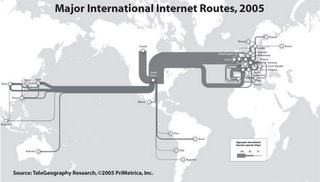 Asia network traffic is following the same trajectory. At some point in the future this is bound to have an impact on the US based carriers. Currently, the US is the top Internet hub country with 1.4 terabits/second of bandwidth. World’s fattest pipes (metaphorically speaking) are between London and New York, about 320 GB/s of bandwidth.
Will the regionalization of the traffic mean price wars will rear their ugly head? Will the prices plunge on the London-New York routes as once again capacity outstrips demand? Some folks who work in the bandwidth business are muttering that the transit fees, that once used to make up nice profit center for global carriers, are beginning to wane. This probably explains at least part of the back story in the flap between Level3 and Cogent over private peering last month. (People don't want pay Level3's rates for transit anymore... they're often seen as too high.)
Looking beyond the obvious - is this a general global economic trend? I won't pretend to know anything substantive about global trade, but my broadband crystal ball (with fresh batteries and all!) indicates that this could be forbearer of a global trade shift. I believe that what oceanic/sea routes, air routes and highways were to the 20th century, broadband pipes are to the 21st century. From that perspective, things could be shifting away from the US being the hub of global trade. [Is that news to anyone on the investment banking sector? I think not!]
(Adapted from Om Malik's Broadband Blog)
Why? For starters, calls between the two countries untill recently were routed through Europe/US. Now traffic will no longer need to travel half way across the planet. Here in the south, we would have called that going around your elbow to get to your behind. This means reduced role for major US carriers like Level 3, MCI and AT&T (currently the world’s largest ISP... yes, they finally bested MCI/UUnet thanks to the SBC merger). It appears this trend is gathering momentum, and slowly network traffic that almost always used to flow through US is becoming more and more regional. Through most of the 1990s it was cheaper to connect individual European Union (EU) countries through US. In the late 90's and early 2000, small regional networks started to siphon off traffic a country at a time.
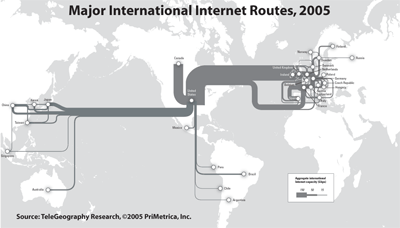 Asia network traffic is following the same trajectory. At some point in the future this is bound to have an impact on the US based carriers. Currently, the US is the top Internet hub country with 1.4 terabits/second of bandwidth. World’s fattest pipes (metaphorically speaking) are between London and New York, about 320 GB/s of bandwidth.
 Will the regionalization of the traffic mean price wars will rear their ugly head? Will the prices plunge on the London-New York routes as once again capacity outstrips demand? Some folks who work in the bandwidth business are muttering that the transit fees, that once used to make up nice profit center for global carriers, are beginning to wane. This probably explains at least part of the back story in the flap between Level3 and Cogent over private peering last month. (People don't want pay Level3's rates for transit anymore... they're often seen as too high.)
Looking beyond the obvious - is this a general global economic trend? I won't pretend to know anything substantive about global trade, but my broadband crystal ball (with fresh batteries and all!) indicates that this could be forbearer of a global trade shift. I believe that what oceanic/sea routes, air routes and highways were to the 20th century, broadband pipes are to the 21st century. From that perspective, things could be shifting away from the US being the hub of global trade. [Is that news to anyone on the investment banking sector? I think not!]
(Adapted from Om Malik's Broadband Blog)
Thursday, November 17, 2005
White House Hijacks Patriot Act Reform
ACLU Says White House Usurps Patriot Act Reauthorization Process, Negotiators Neglect Privacy and Civil Liberties Concerns but Add Poison Pills
 WASHINGTON - A conference committee tasked to reconcile differences between House and Senate Patriot Act bills ignored bipartisan calls to restore checks and balances on government power and protect privacy and civil liberties, the American Civil Liberties Union said today. The Republican-led conferees also attached several "poison pill" measures to the must-pass legislation, unrelated to the 2001 anti-terrorism law. The House and Senate are expected to vote on the bill this week.
The following can be attributed to Lisa Graves, ACLU Senior Counsel for Legislative Strategy:
"The Patriot Act was bad in 2001, and despite bipartisan calls for reform, it's still bad in 2005. Instead of addressing the real concerns that millions of Americans have about the Patriot Act, the Republican majority in Congress buckled to White House pressure, stripping the bill of modest yet meaningful reforms. Congress must reject this bill.
"Don't be fooled by some lawmakers spinning this bill as Patriot Act reform. It’s anything but. Lawmakers have let the administration take us from bad to worse. There's a reason why groups like the Chamber of Commerce, American Conservative Union and American Library Association have all come together for Patriot Act reform. The question is: Why haven’t lawmakers listened?"
WASHINGTON - A conference committee tasked to reconcile differences between House and Senate Patriot Act bills ignored bipartisan calls to restore checks and balances on government power and protect privacy and civil liberties, the American Civil Liberties Union said today. The Republican-led conferees also attached several "poison pill" measures to the must-pass legislation, unrelated to the 2001 anti-terrorism law. The House and Senate are expected to vote on the bill this week.The following can be attributed to Lisa Graves, ACLU Senior Counsel for Legislative Strategy:
"The Patriot Act was bad in 2001, and despite bipartisan calls for reform, it's still bad in 2005. Instead of addressing the real concerns that millions of Americans have about the Patriot Act, the Republican majority in Congress buckled to White House pressure, stripping the bill of modest yet meaningful reforms. Congress must reject this bill.
"Don't be fooled by some lawmakers spinning this bill as Patriot Act reform. It’s anything but. Lawmakers have let the administration take us from bad to worse. There's a reason why groups like the Chamber of Commerce, American Conservative Union and American Library Association have all come together for Patriot Act reform. The question is: Why haven’t lawmakers listened?"
Thursday, October 27, 2005
DoD Buying Sprint's iDEN Network
The PCS Intel Blog is running a story that indicates the Department of Defense will be buying Sprint's iDEN network as "the first phase of a national overhaul of its security framework in regards to communication." The gist is that the government will move much of its wireless communications onto one encrypted wireless network, and Sprint/Nextel customers will be issued dual-network CDMA/iDEN handsets, so that as iDEN becomes restricted, CDMA will take its place.
The report also claims that in exchange, Sprint will get plenty of spectrum in the 700 & 800Mhz bands for mobile Wimax broadband service. Keep in mind that if true, most of this wouldn't happen until around 2010, which roughly gels with Wimax analyst timeline predictions. The report claims the deal won't even be announced until 2007 or 2008.
This move makes this week's news of a Sprint co-branding wireless deal with Comcast, Time Warner Cable, and Cox slightly more interesting. The deal would give Sprint priority access to Wimax spectrum, letting those three cable giants offer re-branded Wimax to better compete with baby Bell Wimax offerings.
This whole scenario assumes a lot; at the forefront that mobile Wimax is a solid business model. If Wimax tanks however, the report seems to indicate that Sprint's deal with Uncle Sam allows them to instead grab ample 2.5 GHz spectrum, and deploy the most popular technology at the time (like WiBro).
Either way, the cable industry would be well positioned for wireless broadband competition.
DoD iDEN
The United States of America has come to a fundamental conclusion about its national communications infrastructure post-9/11 in regards to homeland security; it's broken. The Department of Defense, working with the FCC, DHS, the President, and Congress has brokered a framework agreement to purchase Sprint Nextel's iDEN network as the first phase of a national overhaul of its security framework in regards to communication.
The plan is simple; everyone involved in securing this nation will be on the same network. This network will be using an encrypted iDEN sequence, ensuring that all soldiers, first responders, and chain of command will be able to contact each other. This is especially in the event of a series of disasters in concert (say, for example, multiple terrorist attacks in multiple major metropolitan areas simultaneously).
We do not intend to disclose details of the inner-workings or how DoD iDEN will differ from the current iDEN. We will only say that the transition will be announced approximately two to three years from the deprecation date of iDEN at 2010. All Nextel customers will be issued dual-network CDMA/iDEN handsets, so that as iDEN is barred from consumer use, CDMA will take its place.
Sprint WiMax
We are finally ready to disclose Sprint's master plan for WiMax as well. Sprint intends to deploy a national, non-fixed WiMax network with as much, if not more coverage than the existing CDMA network. WiMax will effectively act as a replacement to CDMA data, providing FIOS-like speeds via massive towers that resemble TV towers in major cities.
This will enable Sprint to not only be a national ISP, but to remove common conceptions of fixed ISP. The WIMax modem technology Sprint is attempting to deploy will ensure that a broad range of WiMax devices will share an account... for example, WiMax deployments could fit in a PDA that would share bandwidth allocations with home internet that would share bandwidth allocations with your HDTV.
Sprint intends to compete directly with Cable, Satellite, ISPs, and traditional Wireless. By bundling all telecommunication services ever envisioned, Sprint will tackle everyone by offering everything.
Now, how is Sprint going to get there? Sprint has multiple hurdles it must cross in order to obtain this vision. First, Sprint must gain a WiMax standard. Sprint is doing this by attempting to force WiMax standards through as an open modem technology... one WiMax device is compatible with another, and is mobile from the start. If this fails, Sprint will most likely divert to the nearest derivative of WiMax, currently WiBro, though Flash-ODFM is an additional fallback should such subsequent technologies also fail.
But, Sprint was late to the WiMax game... Sprint lacks the licenses to deploy a national WiMax network on the critical 700 MHz band.
In comes the FCC. As a part of the transaction of iDEN to the federal government, Sprint will gain a blank check to rebuild the 700 and 800 MHz bands in their image, taking licenses as needed from whoever has them regardless of how fairly they gained them at FCC auction in the past. With Congress, the FCC, and the President in the loop, Forsee, Donahue, and Lauer will have no problem in gaining dominance of the WiMax and digital CDMA 800 MHz spectrum needed to reform technologies in their image.
The final step in this strategy is bandwidth. As you may know, local loops to existing cellular structure generally tap out at about 10 T1 lines per tower in a high traffic cell site. Sprint will form a network coalition to utilize dark fiber across the country to connect the city-wide WiMax towers whenever possible, feeding into Sprintlink backbones in order to ensure that the entire network is able to deliver above-DSL speeds to all customers at all times. Clearly, the goal is to make all metropolitan areas at least initially wired via fiber, and eventually, to create a national fiber optics "spine" that will connect every citizen wirelessly to a fiber optics internet directly.
The Rebels Fight Back
We are reporting all of this today, which we have known and been briefed on for an extremely long time, because we have been notified that Sprint's competition, namely WiMax ISP newcomers that you probably have never heard of before, have learned this information above within the past week.
In short, they are flying to Washington D.C. to fight back in Congress and with the FCC. Now aware to these plans, they see that all their technology investments will go to waste if the FCC choses to pull their 700 MHz licenses key to WiMax "in the public interest". While we love a good behind-the-scenes fight, we have been informed this news will become public domain later this week.
Remember, these "rebels" have nothing to lose, and they intend to scream from the highest mountains this in a war between Sprint and Sprint's hardware suppliers, and the rest of the WiMax forum.
Sprint also has options if their plan fails. We have obtained intelligence recently that Sprint will deploy on the 2.5 GHz spectrum if they are unable to obtain sufficient 700 MHz spectrum. However, the inherent advantages of 700 MHz spectrum over 2.5 GHz spectrum, combined with the added ability to strike a major blow to dissent from Sprint’s vision of WiMax makes it a battle well worth fighting to Sprint.
The PR Spin Rooms Are Spinning
"When the United States depends on the power and performance of Sprint's networks, then yes, I guess I am a Yes Man."
- President Bush, circa 2007
Cue the Sprint pin drop, "Sprint, yes you can", etc. Sprint is billing this strategy as one that will secure the nation, and deliver on the President's promise of national broadband internet by 2010. There are many more details that we are aware of, however, in the sake of national security we will not disclose them here. Again, it is important to note that what is disclosed here will become public domain within the week, however, this is clearly a win-win for all parties involved.
The Editorial
I'm sure many of you will ask my personal thoughts on this. Personally, I think it is the most amazing cooperation between corporate, technological, and political facets of society to-date. It will secure the country, and deliver something that no other technological society has ever offered; wireless broadband internet for everyone. It will ensure that every commander can communicate to every single person he or she is in command of, either through the chain of command or directly at any time. It will ensure that the United States will be the leader in wireless communication and national communications security for the next 25 years.
Bring it on.
The report also claims that in exchange, Sprint will get plenty of spectrum in the 700 & 800Mhz bands for mobile Wimax broadband service. Keep in mind that if true, most of this wouldn't happen until around 2010, which roughly gels with Wimax analyst timeline predictions. The report claims the deal won't even be announced until 2007 or 2008.
This move makes this week's news of a Sprint co-branding wireless deal with Comcast, Time Warner Cable, and Cox slightly more interesting. The deal would give Sprint priority access to Wimax spectrum, letting those three cable giants offer re-branded Wimax to better compete with baby Bell Wimax offerings.
This whole scenario assumes a lot; at the forefront that mobile Wimax is a solid business model. If Wimax tanks however, the report seems to indicate that Sprint's deal with Uncle Sam allows them to instead grab ample 2.5 GHz spectrum, and deploy the most popular technology at the time (like WiBro).
Either way, the cable industry would be well positioned for wireless broadband competition.
DoD iDEN
The United States of America has come to a fundamental conclusion about its national communications infrastructure post-9/11 in regards to homeland security; it's broken. The Department of Defense, working with the FCC, DHS, the President, and Congress has brokered a framework agreement to purchase Sprint Nextel's iDEN network as the first phase of a national overhaul of its security framework in regards to communication.
The plan is simple; everyone involved in securing this nation will be on the same network. This network will be using an encrypted iDEN sequence, ensuring that all soldiers, first responders, and chain of command will be able to contact each other. This is especially in the event of a series of disasters in concert (say, for example, multiple terrorist attacks in multiple major metropolitan areas simultaneously).
We do not intend to disclose details of the inner-workings or how DoD iDEN will differ from the current iDEN. We will only say that the transition will be announced approximately two to three years from the deprecation date of iDEN at 2010. All Nextel customers will be issued dual-network CDMA/iDEN handsets, so that as iDEN is barred from consumer use, CDMA will take its place.
Sprint WiMax
We are finally ready to disclose Sprint's master plan for WiMax as well. Sprint intends to deploy a national, non-fixed WiMax network with as much, if not more coverage than the existing CDMA network. WiMax will effectively act as a replacement to CDMA data, providing FIOS-like speeds via massive towers that resemble TV towers in major cities.
This will enable Sprint to not only be a national ISP, but to remove common conceptions of fixed ISP. The WIMax modem technology Sprint is attempting to deploy will ensure that a broad range of WiMax devices will share an account... for example, WiMax deployments could fit in a PDA that would share bandwidth allocations with home internet that would share bandwidth allocations with your HDTV.
Sprint intends to compete directly with Cable, Satellite, ISPs, and traditional Wireless. By bundling all telecommunication services ever envisioned, Sprint will tackle everyone by offering everything.
Now, how is Sprint going to get there? Sprint has multiple hurdles it must cross in order to obtain this vision. First, Sprint must gain a WiMax standard. Sprint is doing this by attempting to force WiMax standards through as an open modem technology... one WiMax device is compatible with another, and is mobile from the start. If this fails, Sprint will most likely divert to the nearest derivative of WiMax, currently WiBro, though Flash-ODFM is an additional fallback should such subsequent technologies also fail.
But, Sprint was late to the WiMax game... Sprint lacks the licenses to deploy a national WiMax network on the critical 700 MHz band.
In comes the FCC. As a part of the transaction of iDEN to the federal government, Sprint will gain a blank check to rebuild the 700 and 800 MHz bands in their image, taking licenses as needed from whoever has them regardless of how fairly they gained them at FCC auction in the past. With Congress, the FCC, and the President in the loop, Forsee, Donahue, and Lauer will have no problem in gaining dominance of the WiMax and digital CDMA 800 MHz spectrum needed to reform technologies in their image.
The final step in this strategy is bandwidth. As you may know, local loops to existing cellular structure generally tap out at about 10 T1 lines per tower in a high traffic cell site. Sprint will form a network coalition to utilize dark fiber across the country to connect the city-wide WiMax towers whenever possible, feeding into Sprintlink backbones in order to ensure that the entire network is able to deliver above-DSL speeds to all customers at all times. Clearly, the goal is to make all metropolitan areas at least initially wired via fiber, and eventually, to create a national fiber optics "spine" that will connect every citizen wirelessly to a fiber optics internet directly.
The Rebels Fight Back
We are reporting all of this today, which we have known and been briefed on for an extremely long time, because we have been notified that Sprint's competition, namely WiMax ISP newcomers that you probably have never heard of before, have learned this information above within the past week.
In short, they are flying to Washington D.C. to fight back in Congress and with the FCC. Now aware to these plans, they see that all their technology investments will go to waste if the FCC choses to pull their 700 MHz licenses key to WiMax "in the public interest". While we love a good behind-the-scenes fight, we have been informed this news will become public domain later this week.
Remember, these "rebels" have nothing to lose, and they intend to scream from the highest mountains this in a war between Sprint and Sprint's hardware suppliers, and the rest of the WiMax forum.
Sprint also has options if their plan fails. We have obtained intelligence recently that Sprint will deploy on the 2.5 GHz spectrum if they are unable to obtain sufficient 700 MHz spectrum. However, the inherent advantages of 700 MHz spectrum over 2.5 GHz spectrum, combined with the added ability to strike a major blow to dissent from Sprint’s vision of WiMax makes it a battle well worth fighting to Sprint.
The PR Spin Rooms Are Spinning
"When the United States depends on the power and performance of Sprint's networks, then yes, I guess I am a Yes Man."
- President Bush, circa 2007
Cue the Sprint pin drop, "Sprint, yes you can", etc. Sprint is billing this strategy as one that will secure the nation, and deliver on the President's promise of national broadband internet by 2010. There are many more details that we are aware of, however, in the sake of national security we will not disclose them here. Again, it is important to note that what is disclosed here will become public domain within the week, however, this is clearly a win-win for all parties involved.
The Editorial
I'm sure many of you will ask my personal thoughts on this. Personally, I think it is the most amazing cooperation between corporate, technological, and political facets of society to-date. It will secure the country, and deliver something that no other technological society has ever offered; wireless broadband internet for everyone. It will ensure that every commander can communicate to every single person he or she is in command of, either through the chain of command or directly at any time. It will ensure that the United States will be the leader in wireless communication and national communications security for the next 25 years.
Bring it on.
Tuesday, October 18, 2005
Verizon EVDO: Unlimited, Isn't
Customers receive bandwidth consumption letters
Verizon's EVDO wireless broadband service promises unlimited data consumption, but as usual in this industry - that means the exact opposite. Verizon Wireless had already been complaining about the use of Junxion boxes to split 3G connections. Now, according to posters to the EVDO forums (via Techdirt), they're sending out warning letters (see copy) to users who consume too much bandwidth. We're not sure how many times we have to say this: If you're going to restrict consumption in any way, then don't tag your service as "unlimited".
Verizon's EVDO wireless broadband service promises unlimited data consumption, but as usual in this industry - that means the exact opposite. Verizon Wireless had already been complaining about the use of Junxion boxes to split 3G connections. Now, according to posters to the EVDO forums (via Techdirt), they're sending out warning letters (see copy) to users who consume too much bandwidth. We're not sure how many times we have to say this: If you're going to restrict consumption in any way, then don't tag your service as "unlimited".

Thursday, October 13, 2005
10,000 Midtown NY Phones Dead
A major phone outage in Midtown has left thousands of people without dial tones, and a solution is still days away. Landlines, Internet access and fax machines for many Verizon customers in the area have been shut down since Tuesday after a fire melted cables inside a manhole at 38th Street and Madison Avenue.
Verizon, which doesn't know the cause of the fire, said yesterday that as many as 10,000 customers in both homes and businesses are still without landlines in the heart of the city.
"At this point, we haven't estimated how soon we'll have it [repairs] all done . . . possibly sometime next week," said Verizon spokesman Cliff Lee.
"It's going to be a very time-consuming process, because of the situation and the [underground] location."
To ease the pain, Verizon has placed vans with free phones for the public to use in the affected area and will offer rebates for affected customers. But the outage has business owners fuming as they struggle to operate without fax machines, e-mail or regular phones.
"It's impossible to run a law firm without e-mail and faxes in 2005," said Paul Korngold, a partner at Tuchman, Katz, Schwartz, Gelles, Korngold and Weiss, whose lines have been down since the start of business on Wednesday.
It's still not clear what sparked the manhole fire that caused the problem. Verizon said that by yesterday workers had gotten fiber optic lines working, but they still had to repair melted copper wires.
Verizon, which doesn't know the cause of the fire, said yesterday that as many as 10,000 customers in both homes and businesses are still without landlines in the heart of the city.
"At this point, we haven't estimated how soon we'll have it [repairs] all done . . . possibly sometime next week," said Verizon spokesman Cliff Lee.
"It's going to be a very time-consuming process, because of the situation and the [underground] location."
To ease the pain, Verizon has placed vans with free phones for the public to use in the affected area and will offer rebates for affected customers. But the outage has business owners fuming as they struggle to operate without fax machines, e-mail or regular phones.
"It's impossible to run a law firm without e-mail and faxes in 2005," said Paul Korngold, a partner at Tuchman, Katz, Schwartz, Gelles, Korngold and Weiss, whose lines have been down since the start of business on Wednesday.
It's still not clear what sparked the manhole fire that caused the problem. Verizon said that by yesterday workers had gotten fiber optic lines working, but they still had to repair melted copper wires.
Friday, October 07, 2005
The Best Geek Quotes
- There are 10 types of people in the world: those who understand binary, and those who don't.
- If at first you don't succeed; call it version 1.0
- I'm not anti-social; I'm just not user friendly
- Roses are #FF0000
Violets are #0000FF
All my base
Are belong to you
- My software never has bugs. It just develops random features.
- My pokemon bring all the nerds to the yard, and they're like you wanna trade cards? Darn right, I wanna trade cards, I'll trade this but not my charizard.
- Microsoft: "You've got questions. We've got dancing paperclips."
- A computer lets you make more mistakes faster than any invention in human history - with the possible exceptions of handguns and tequila.
- I would love to change the world, but they won't give me the source code.
- The box said 'Requires Windows 95 or better'. So I installed LINUX.
Tuesday, October 04, 2005
Health Insurance Search Engine
NEED Health Insurance? In addition to featuring the largest selection of major medical health plans from leading companies, eHealthInsurance also offers a wide selection of quality short term, student, and dental plans. You can obtain FREE instant quotes, side-by-side comparisons, the best available prices, online applications, and a knowledgeable Customer Care team to help you find the plan that is right for you. ShopforT1 revolutionized shopping for T1 and internet circuits. Now eHealthInsurance revolutionizes shopping for health insurance.
Sunday, October 02, 2005
For Verizon VoIP, Unlimited Really Means 5000 Minutes
Verizon VoiceWing fine-print on unlimited plans.
Verizon reserves the right to monitor usage for possible abuse of service. For packages with unlimited calling, more than 5,000 minutes a month is considered beyond normal residential use and may be investigated, resulting in potential termination of service.That’s about 3 hours a day… not a lot of talk time! (Hat Tip, Chris Holland)
Monday, September 26, 2005
VoIP a not quite ready for primetime player
Subscribe to:
Posts (Atom)