Tuesday, September 13, 2005
Cingular Wireless expelled from the Better Business Bureau
After a string of unanswered complaints, Cingular Wireless has been expelled from the Better Business Bureau of Upstate New York. Cingular has 20 unanswered complaints out of over 200 in the last three years, according to a report. "We want to set this right. We will be meeting with BBB representatives to address any outstanding issues they may have, and we will apply for reinstatement as soon as possible. It's very important for us to be a member in good standing," a Cingular spokesperson said.


Thursday, September 08, 2005
Powerful solar flare erupts
One of the largest solar flares on record was recorded by forecasters at the NOAA Space Center in Boulder, Colo. at 1:40 p.m. EDT on Sept. 7. Forecasters are predicting significant solar eruptions over the next few days. Electric power systems, high frequency communications, low-frequency navigation systems and spacecraft operations may experience disruptions over the next two weeks.
Tuesday, September 06, 2005
What can you and your church do to help with Katrina?
This is a synthesis of all the good ideas I've heard to date...
- Look for an organization to match your financial donations. Many companies are offering to match Katrina relief donations 1:1 - meaning you can double the effectiveness of your donation with zero additional work. For example, dealnews will match 100% of your donation to the American Red Cross, up to a total of $5,000. Their goal is to raise a total of $10,000 including yours and our donations. Click here to read more and to donate.
- Mobile laundry stations. Furnish enclosed trailers with 2-3 washing machines, 3-4 dryers, and water heaters. Take those to shelters, outreach churches, etc. so people can wash their dirty clothing.
- Mobile homes, trailers, RVs. People need places to live. And they need them *IN* LA and MS, not thousands of miles away. Find used RVs, inexpensive mobile homes/trailers, etc. Locate those at churches, local/state/federal parks and recreation areas, or find suitable RV or mobile home pads. Partner with a local church in LA or MS to provide a parking spot and utilities (power, water, etc.) for these units.
- Donate cell phone minutes. 10's of thousands of people still have not been able to contact their family, friends and loved ones. Take your cell phone or a group of cell phones to shelters, effected areas, etc. and allow people to use those phones to call out.
- Organize job fairs. Estimates indicate about a million people will need at least temporary jobs. Get the businesses in your area together and help them understand the need to get those people gamefully employed so they can support their family.
- Collect school supplies and send them to major school systems in Texas. Also to everywhere in southern Mississippi, Baton Rouge LA, etc. Many school systems in Texas, most in Mississippi and most in Louisiana have a *major* influx of students to cope with. All these students need get back into school so they can have some form of normalcy in their life.
- Organize groups of tutors. See above. These same students are going to need lots of help getting up to speed in school and keeping up. I hesistate to say it... but LA did have the 49th ranked school system in the US. Lots of kids there are going to need lots of help assimilating into schools with higher standards.
Red Cross Shelter Statistics
The American Red Cross said Monday it had 487 shelters and evacuation centers open and was caring for at least 142,121 hurricane victims in 16 states. These figures do not include refugees still in New Orleans, or at hotels, motels or church or state shelters across the South. (As of 9:30pm Monday night.)
Here is a breakdown of Red Cross shelters in eight states:
-
Texas: 74 shelters, including the Astrodome; 56,000 people
-
Louisiana: 175 shelters; 55,000 people
-
Mississippi: 113 shelters; 17,000 people
-
Alabama: 48 shelters; 5,200 people
-
Florida: 41 shelters; 3,600 people
-
Arkansas: 7 shelters; 3,000 people
-
Georgia: 17 shelters; 1,100 people
-
Tennessee: 3 shelters; 1,000 people
Monday, August 29, 2005
Summer Travelers Want Broadband
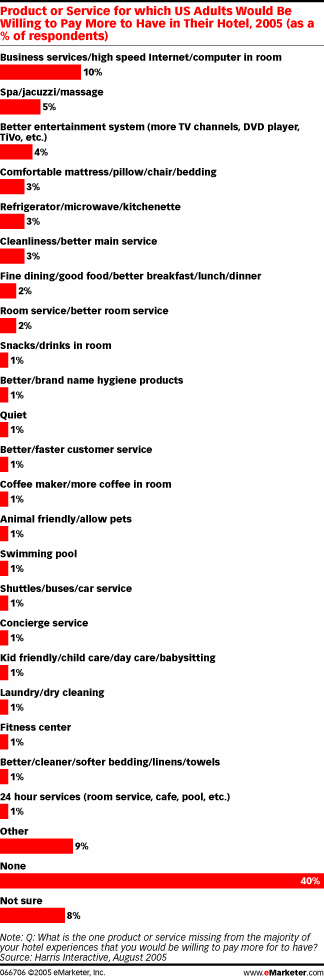
When travelers where asked what hotel product or service they would they would be willing to pay extra for, high-speed Internet access or a computer in the room topped the list.
As Labor Day approaches, a new survey from Harris Interactive finds that two-thirds (66%) of US adults have taken or will take a vacation this summer.
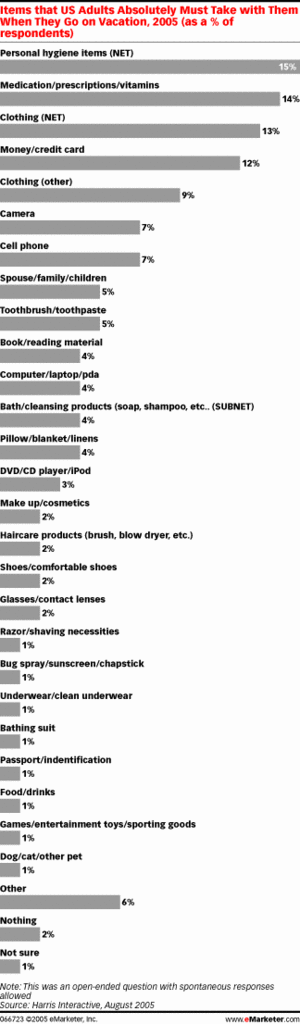
When asked what is the one thing they "absolutely must take with them" when traveling on vacation, Americans were most likely to say personal hygiene items (15%). Computers were far down the list. (click graph to view)
But travelers still want the ability to go online, and fast. When asked what was missing from their hotel stays that they would most be willing to pay extra for, high-speed Internet access or a computer in their room topped the list at 10%. Better entertainment, such as DVD or Tivo, was third. (click graph to view)
Friday, August 26, 2005
Your VoIP Line May Be Terminated Next Week
If you don't acknowledge the 911 service sucks
Written by Karl BodeIf you don't respond to your VoIP provider's emails concerning the limitations of 911 service, you could find your service terminated early next week. It's part of an FCC order many providers claim is unreasonable, and at least one is suing over. Doesn't matter whether you use it on DSL, a T1 or a DS3! Everyone is affected.
Back in May a mother blamed Vonage 911 service for her baby's death, despite the fact Vonage proved to local news outlets that the 911 call in question went through - twice. That didn't seem to matter. This and other similar reports created an uproar, and VoIP 911 became a hot political issue.
In some instances the problem was that customers didn't carefully read this screen, alerting them that they must manually configure 911 service before use. The customer complaints led several states to sue Vonage. Vonage responded by routing everyone to 911 centers, regardless of whether they'd configured the service or not.
Too late.
Despite the fact that on any given day you can find ample examples of traditional 911 failures, VoIP 911 was now an FCC and Congressional target. This prompted the creation of new laws, and an FCC order demanding all VoIP providers offer 911 service by November (some VoIP industry insiders believe this is a trojan horse effort to eliminate bell competition).
VoIP provider Nuvio has decided to sue the FCC over the 120 day window, claiming the request "unreasonable, arbitrary, and because technologically infeasible, capricious."
As part of the order, providers were also told they had to get 100% customer acknowledgement of the limitations of VoIP 911 by August 29.
That request also hasn't sat well with VoIP providers. “You could tell people that their house is burning down and by clicking on this link you can stop it and only 60 percent of them would respond,” recently noted VoicePulse CEO Ravi Sakaria.
As the hour grows late, VoIP providers have grown desperate - flinging the "our 911 service sucks" confirmation emails far and wide. Our office receives at least one a day, and we're not even a current customer.
Time Warner Cable meanwhile claims they've gotten all 600,000 VoIP customers to respond (sure they did, says CNET's Russell Shaw).
Vonage states they've received confirmation from roughly 96% of their subscribers. If the estimated remaining 31,000 subscribers don't respond to Vonage by next week, they will find their services terminated.
Back in May a mother blamed Vonage 911 service for her baby's death, despite the fact Vonage proved to local news outlets that the 911 call in question went through - twice. That didn't seem to matter. This and other similar reports created an uproar, and VoIP 911 became a hot political issue.
In some instances the problem was that customers didn't carefully read this screen, alerting them that they must manually configure 911 service before use. The customer complaints led several states to sue Vonage. Vonage responded by routing everyone to 911 centers, regardless of whether they'd configured the service or not.
Too late.
Despite the fact that on any given day you can find ample examples of traditional 911 failures, VoIP 911 was now an FCC and Congressional target. This prompted the creation of new laws, and an FCC order demanding all VoIP providers offer 911 service by November (some VoIP industry insiders believe this is a trojan horse effort to eliminate bell competition).
VoIP provider Nuvio has decided to sue the FCC over the 120 day window, claiming the request "unreasonable, arbitrary, and because technologically infeasible, capricious."
As part of the order, providers were also told they had to get 100% customer acknowledgement of the limitations of VoIP 911 by August 29.
That request also hasn't sat well with VoIP providers. “You could tell people that their house is burning down and by clicking on this link you can stop it and only 60 percent of them would respond,” recently noted VoicePulse CEO Ravi Sakaria.
As the hour grows late, VoIP providers have grown desperate - flinging the "our 911 service sucks" confirmation emails far and wide. Our office receives at least one a day, and we're not even a current customer.
Time Warner Cable meanwhile claims they've gotten all 600,000 VoIP customers to respond (sure they did, says CNET's Russell Shaw).
Vonage states they've received confirmation from roughly 96% of their subscribers. If the estimated remaining 31,000 subscribers don't respond to Vonage by next week, they will find their services terminated.
Tuesday, August 16, 2005
Bank ATMs Converted to Steal IDs of Bank Customers
A team of organized criminals is installing equipment on legitimate bank ATMs in at least 2 regions to steal both the ATM card number and the PIN. The team sits nearby in a car receiving the information transmitted wirelessly over weekends and evenings from equipment they install on the front of the ATM (see photos). If you see an attachment like this, do not use the ATM and report it immediately to the bank using the 800 number or phone on the front of the ATM.
The equipment used to capture your ATM card number and PIN is cleverly disguised to look like normal ATM equipment. A "skimmer" is mounted to the front of the normal ATM card slot that reads the ATM card number and transmits it to the criminals sitting in a nearby car.
At the same time, a wireless camera is disguised to look like a leaflet holder and is mounted in a position to view ATM PIN entries.
The thieves copy the cards and use the PIN numbers to withdraw thousands from many accounts in a very short time directly from the bank ATM.

Equipment being installed on front of existing bank card slot.

The equipment as it appears installed over the normal ATM bank slot.

The PIN reading camera being installed on the ATM is housed in an innocent looking leaflet enclosure.

The camera shown installed and ready to capture PINs by looking down on the keypad as you enter your PIN.
Thursday, August 11, 2005
Official: Computer God
Ok... so I took the geek test and scored a 95. Guess I am a professional geek after all.

Your Score Summary
Overall, you scored as follows:

5% scored higher (more computer geeky),
0% scored the same, and
95% scored lower (less geeky).
Compared to those in the same age group as you:

6% scored higher (more computer geeky),
0% scored the same, and
94% scored lower (less geeky).
What does this mean? Your computer geekiness is:
Step aside Bill Gates, Linus Torvalds, and Steve Jobs... You are by far the SUPREME COMPUTER GOD!!!


Monday, July 25, 2005
Investigating Machine Identification Code Technology in Color Laser Printers
Do you own a color printer or have access to high speed color laser printers? If so, then please take a moment to help the Electronic Frontier Foundation research the breadth of the print tracing systems and mechanisms that have been integrated into these devices without consumer knowledge or government acknowledgement.
Summary: The serial number and other information about your printer could be hidden in every printout. At the request of the United States Secret Service, manufacturers developed mechanisms that print in an encoded form the serial number and the manufacturer's name as indiscernible markings on color documents.
Here is their article and all the info:
(from: http://www.eff.org/Privacy/printers/wp.php)
Introduction
Summary: The serial number and other information about your printer could be hidden in every printout. At the request of the United States Secret Service, manufacturers developed mechanisms that print in an encoded form the serial number and the manufacturer's name as indiscernible markings on color documents.
Here is their article and all the info:
(from: http://www.eff.org/Privacy/printers/wp.php)
Introduction
On Nov. 22, 2004, PC World published an online article stating that "several printer companies quietly encode the serial number and the manufacturing code of their color laser printers and color copiers on every document those machines produce. Governments, including the United States, already use the hidden markings to track counterfeiters." (http://www.pcworld.com/news/article/0,aid,118664,00.asp). According to the article, the high fidelity of outputs from color machines to their original documents suggests that counterfeiters can potentially succeed in creating high-quality counterfeited currency and government documents using these machines. At the request of the United States Secret Service, manufacturers developed mechanisms that print in an encoded form the serial number and the manufacturer's name as indiscernible markings on color documents. The Secret Service and manufacturers would be able to decode these values from the markings and in the event a color machine was used to print a suspected counterfeited document, these values would be used with customer information to discover the identity of the machine's owner.
The U.S. government is not the only national government using the marking technology to deter counterfeiting activities. An Oct. 26, 2004, PC World article entitled "Dutch Track Counterfeits Via Printer Serial Numbers" explained that Dutch railway law enforcement officials were employing this same technology to investigate a large-scale railway ticket counterfeiting operation. According to the article, since information about a user is not encoded into the arrangement of markings, law enforcement agencies work with manufacturers to obtain the identities of the persons to whom the printers were sold. In a typical scenario, when distributors sell printers, they obtain information about the purchaser, which is maintained in a database. The purchaser's identity is then associated with the serial number and the manufacturer's name of the machine. A document whose author a governmental agency wants to discover contains only the serial number and the manufacturer's name of the machine on which it was printed, so upon extracting this information from a document, it must consult the distributor responsible for selling the machine. The distributor performs a database query to match the serial number with a purchaser; manufacturers can also do searches if they have access to the database.
Motivations
In the PC World article, manufacturers and the Secret Service claim that the marking technology was developed to deter counterfeiting activities using color machines. While they may actually use it for legitimate anticounterfeiting purposes, currently no law prevents them from exploiting the technology in ways that could infringe on the privacy and anonymity of Americans. This means that we have no way to require them to adhere to these purposes or even verify that they are the only purposes. We also have no way of knowing whether the Secret Service is the only governmental agency using this technology.
The possible misuses of this marking technology are frightening--individuals using printers to create political pamphlets, organize legal protest activities, or even discuss private medical conditions or sensitive personal topics can be identified by the government with no legal process, no judicial oversight, and no notice to the person spied upon. If the Secret Service or any other governmental body wanted to identify the author of an anonymously printed political pamphlet, it could use the markings on the document to at least determine the serial number and the manufacturer of the machine on which it was printed. Then, with the cooperation of distributors and manufacturers, it could identify who purchased the machine. We do not even know if the government actually needs to consult manufacturers each time it seeks to identify document authors; it could obtain a complete customer database from the manufacturer and simply access the specific information on its own for any purpose it chooses.
Xerox senior research fellow Peter Crean has informed us that each document identification request that Xerox's security department receives from the Secret Service is handled on a case-by-case basis, that Xerox identifies only suspected currency documents, and that identification of machines used to print pamphlets, letters, and other non-currency documents does not occur. If true, these statements are somewhat comforting, but a clear risk remains due to the absence of legislation regulating the use of the marking technology. Color printers are regularly used for anonymous printing and pamphleteering; they are an important tool of speech. Without appropriate legal protections against the misuse of identifying technologies, these long-protected forms of expression may be in danger, as the government has easy and secret ways to identify the authors, or at least the printer purchaser, of any speech printed on color printers.
Furthermore, what assurance does an author have that foreign governments, or even private entities, are not also using or misusing these marking technologies to identify speakers? We're aware of no laws regulating the distribution or reuse of information obtained through the use of marking technologies and customer databases. The Secret Service could share with foreign governments knowledge about interpreting the markings, which would mean that they could identify color documents printed in the United States. Similarly, no law prevents individuals or organizations from using this technology for their own purposes, which means that malicious parties who understand how it works can misuse it.
It is especially worrisome that the Secret Service was able to coordinate with private-sector manufacturers on the development of this technology since at least the early 1990s with no public awareness, much less public discussion, of the privacy and anonymity risks for users of this technology. This raises the general concern that the U.S. government might have promoted the development of identification mechanisms in other devices and might do so in the future with new technologies. The marking technology is possibly one of many instances of the federal government's unwillingness to be forthright with questionable law enforcement techniques. In addition to the serious privacy concerns, we must consider the implications of the government's possible lack of accountability to the public on matters affecting technology use and development.
Through this project, we want to inform current and prospective color laser printer owners, purchasers, and users of this potential privacy risk so that they can make educated consumer decisions. It does not necessarily follow from the presentation of this material that members of the general public should never use color laser printers containing marking technology. We recognize that some consumers, upon being informed, will still choose to use these machines; such a decision is within their discretion. We simply want to ensure that current and prospective owners, purchasers, and users of these machines know that they can be identified using this technology and consider the potential risks. We also want to continue to gather information to make this technology better understood over time.
Methodology
We visited numerous local print stores and printed eight speciallydesigned 8.5" by 11" test sheets, each with a resolution of 600 dpi (see right for two of these test sheets). We initially examined the printed test sheets using a Digital Blue QX5 computer light microscope, but later determined that a blue LED flashlight and a magnifying glass were sufficient to detect the markings, confirming the efficacy of the technique suggested by Xerox senior research fellow Peter Crean (see http://www.pcworld.com/news/article/0,aid,118664,00.asp).
Upon detecting markings on a test sheet, we attempted to describe their arrangement. With Xerox documents, the markings consisted of minuscule yellow dots positioned within a 0.5" by 1.0" rectangular space. The arrangement of dots was repeatedly printed over the entire printed side. These dots were transcribed onto paper and text files. We wrote simple Linux shell scripts and C programs to analyze the arrangements.
With Canon documents, the markings also consisted of tiny yellow dots. However, they were not arranged within a rectangular space, which made analyzing them more challenging. As of this writing, we haven't developed a protocol for analyzing Canon markings, which may require an interpreting scheme different from the one needed to interpret Xerox's. There may be multiple marking systems in use by different manufacturers or in connection with different generations of color printing technology.
Results
Here are images of yellow tracking dots printed by Canon and Xerox printers:
Printed side of test01 sheet
Machine: Canon Color imageRUNNER C3200. Magnified: 60 times.
Unprinted side of test01 sheet
Machine: Canon Color imageRUNNER C3200. Magnified: 60 times.
Printed side of test01 sheet
Machine: Xerox DocuColor 12. Magnified: 60 times.
Yellow dots on blue color box background, test07
Machine: Xerox DocuColor 12. Magnfied: 60 times.
Yellow dots on edge of test09 sheet with blue LED light
Machine: Xerox DocuColor 12. Magnified: 10 times.
Yellow dots on test07 sheet
Machine: Xerox DocuColor 12. Magnified: 60 times.
Below is a list of transcribed dot patterns for Xerox printers in text file format. Pattern pXY refers to the pattern found on test sheet testXY, pattern pXY1_XY2 refers to the shared pattern found on test sheets testXY1 and testXY2, and pattern pXY1-XY2 refers to the shared pattern found on test sheets testXY1 to XY2, inclusive.
Aftering unzipping these files, use WordPad or another text editor to examine them.
- DocuColor 12 (FedEx Kinko's, 201 Sacramento Street, San Francisco, CA)
- DocuColor 12 (FedEx Kinko's, 303 2nd Street, San Francisco, CA)
- DocuColor 12 (FedEx Kinko's, 369 Pine Street)
- DocuColor 40 (Let Us! Copy, 565 Commercial Street, San Francisco, CA)
- DocuColor 2045 (FedEx Kinko's, 369 Pine Street, San Francisco, CA)
- DocuColor 6060 (FedEx Kinko's, 201 Sacramento Street, San Francisco, CA)
- DocuColor 6060 (FedEx Kinko's, 1800 Van Ness Avenue, San Francisco, CA)
Analysis
For Xerox documents, within the 0.5" by 1" rectangular space, 8 x 15 = 120 locations exist for printers to print yellow tracking dots. Consider the following pattern found on test00-template, printed on a Xerox DocuColor 12 located at FedEx Kinko's, 201 Sacramento Street, San Francisco, CA.
   ^      x   x x x   x x x   x   x   x
|
|      x                 x         x
|
|      x x               x x       x
|
|      x x       x       x x x   x
8 dots
|              x         x x x     x
|
|              x x x x   x   x x x x
|
|        x         x     x
|
v      x         x   x   x x   x x

      <--------- 15 dots --------->
We hypothesized that the patterns should be interpreted as binary values of fifteen bytes, where one byte was eight bits long and the more significant bits were written near the top of the pattern. We further postulated that the presence of a yellow tracking dot was equivalent to a "1" and the absence thereof was equivalent to a "0." We used shell scripts to translate these binary values into hexadecimal numbers, reading each column from top to bottom as a byte and taking columns in order from left to right. Below are the fifteen hexadecimal representations generated for the above Xerox DocuColor 12 pattern:
F1 32 80 80 8C 15 86 85 80 7F B9 1C 85 15 EC
It is difficult to discover their significance without printer information such as a serial number. These values could be encrypted, which could thwart analysis. When we obtain more data, including the serial numbers of machines, we look forward to determining the meaning of the bit fields in this pattern. Our analysis could be enhanced when we obtain the serial numbers of color machines.
List of Printers
Below is a list of printers that do and do not print yellow tracking dots on documents. Although we qualify these dots as "tracking dots," we have not proven that they indeed encode identifying information. Crean's testimony in the PC World article and the pattern differences between numerous printers suggest that these dots encode relevant information, but we still need to demonstrate that they do. With all of these printers, there might be another form of marking technology being used in addition to the system of yellow dots. Watermarking and steganographic techniques have become elaborate and complex, so one cannot rule out their use in printer documents. One could argue that the real identifying information is encoded using a complicated, statisticallybased algorithm, and the yellow dots are merely decoys (created using random values at the time of printing) to prevent people from examining the real marking technology. Thus, the presence or absence of yellow tracking dots on a document does not prove that no other form of marking technology is being used.
With these caveats, we present the following lists. Only one printer that we tested did not print yellow tracking dots:
Xerox (list obtained through EFF's empirical research)
- TekTronix Phaser 7700
Here is a list of printers that print yellow tracking dots:
Canon (list obtained through EFF's empirical research)
- CLC 1000
- CLC 2400 with Fiery RIP
- Color imageRUNNER C3200
- eStudio3100c
- eStudio2100c
- eStudio311c
- eStudio211c
- eStudio310c
- eStudio210c
- FC70
- FC15
- FC22
- FC25P
- FC22i
- FC25Pi
- FC15i
- DocuColor 12
- DocuColor 40
- DocuColor 2045
- DocuColor 2000 series (obtained from Fuji Xerox's product information; it is possible that this information is applicable only to Xerox machines manufactured or sold in China)
- DocuColor 6060 (see Fuji Xerox's product information for confirmation; it is possible that this information is applicable only to Xerox machines manufactured or sold in China)
- WorkCentre Pro series (obtained from the PC World article)
FOIA Request
EFF is also trying to discover information on this subject through a Freedom of Information Act (FOIA) request to the United States Secret Service.
Conclusions
Our project's work confirms that one form of marking technology is being used in color laser printers. There could certainly be other forms of marking involved. Consumers can easily test whether printers are printing yellow tracking dots on their documents by flashing a blue LED light onto the white parts of their document. If numerous black dots appear (yellow becomes black under a blue LED light) with a semblance of structure, it is likely that the document contains tracking dots.
What You Can Do to Help EFF
We always appreciate the help of our members and supporters. You can help us make further progress with this project. Ask manufacturers of color laser printers and color photocopiers to disclose information on this technology and to explain why it is not publicized or brought to the consumer's attention at the point of sale.
You can also help us through a more hands-on approach. If you own, operate, or have legitimate access to color laser printers or color photocopiers, please print the eight test sheets provided below on each of the machines to which you have access and send them to EFF (see address below). If there are printing stores near where you live or work, please print the eight test sheets there and send them to us. Please also print a configuration page, which will tell us information about the printer. If you cannot obtain a configuration page, please obtain the name of the manufacturer, the model type, and, if you can, the serial number. Unfortunately, EFF cannot reimburse costs incurred in printing these documents. In the event that all eight test sheets cannot be printed, please try to print as many as you can. Please print or request printing of these test sheets on normal laser printer paper and in consecutive order based on their filenames' numbering. If you plan to send us more than one machine's test sheets, please keep them separated (preferably in folders) to prevent data mixing.
Please include this information form (PDF) within each folder, to help EFF identify whence the test sheets came.
Test sheets printed in foreign countries are welcome. Please send test sheets until Nov. 1, 2005.
Test sheets:
- test00-template.pdf (154 KB)
- test01-eff_white.pdf (174 KB)
- test02-eff_blue.pdf (181 KB)
- test03-black_square.pdf (181 KB)
- test04-blue_square.pdf (180 KB)
- test05-pale_green_square_008857.pdf (175 KB)
- test06-text.pdf (174 KB)
- test07-checkerboard.pdf (108 KB)
Send test sheets to:
Electronic Frontier Foundation
Machine Identification Code Technology Project
454 Shotwell Street
San Francisco, CA 94110-1914
U.S.A.
Tuesday, July 12, 2005
Want to complain about Dell? Forget it
By Charles Arthur (feedback at theregister.co.uk)
Want to complain on Dell's website about its customer service? Too late - the Customer Support Forums, operational until last Friday, have been shut down, apparently to try to quell bad publicity there about Dell products and especially after-care service.
While all the other equipment forums are still working - last time we looked - the areas where you could vent your anger or delight about Mikey Boy's company were shut with a peremptory notice (Link) saying that "The Customer Service boards on the Dell Community Forum will be retiring at 3:30pm this Friday, July 8th. ... Customer Service FAQs will still be available to help answer your questions. If you need further assistance, you may contact our customer service team via Chat for any non-technical issue you may have." (The UK site appears not to have such a forum.)
Why? Could it be anything to do with the unbelievably corrosive effect on Dell's reputation that has followed its insistent refusal to deal with problems with the Dell Dimension 4600 power supply (Link)?
Noted Windows expert Ed Bott, who has been tying together some of the threads of the tale, comments: "Dell continues its race to the bottom with the new management strategy: If your customers continue to ask annoying questions, stop listening."
Dell didn't have a response to our query about why it had shut the forums, although in a chat with Christoper Carfi (Link) one Dell service bod said: "We are closing the Customer Service boards on the Dell Community Forum for the time being as there certain updates which needs to be taken care of."
Dell is not the first company to find its customers revolting online; Apple has taken similar measures (Link) in the past, though not gone quite as far as deleting an entire category of discussion.
Part of the problem seems to have stemmed from Jeff Jarvis, a columnist on the San Francisco Examiner, who summed up his anger in a letter to a Dell VP, saying: "This machine is a lemon. Your at-home and complete care service is a fraud. Your customer service is appalling. Your product is dreadful. Your brand is mud."
That has snowballed into growing pressure on Dell to improve its customer service, at precisely the time it has been driving ever-harder to improve margins. Unfortunately, the two conflict: excellent customer service can't be measured by standard accounting metrics because it doesn't show up until people renew purchases or service contracts - which is a future, uncertain, event. However, you can cut costs in customer service today and it shows up in the bottom line.
Jarvis's travails sparked a little civil war in Blogistan, where some thought he deserved special treatment from Dell as an "A-lister" and "influential", while Bott pointed out (Link) that "Google Dell customer service problems and you get 2,950,000 hits (Link), which seems like a lot by any standards. (Just to check, we did "Britney Spears" customer service problems (Link) and got only 181,000 results. It's good, Britney, but there's still work to do.)
In fact Dell's growth has clearly been putting increasing strain on its customer service operations. In 2000 it won high marks in a PC World survey (Link) of subscribers. But fast forward to 2004 and it was slipping badly (Link).
Meanwhile, Jarvis found his own solution to his problems. He bought an Apple Powerbook (Link). Doubtless Apple's moderators are already readying their "delete" keys.
Want to complain on Dell's website about its customer service? Too late - the Customer Support Forums, operational until last Friday, have been shut down, apparently to try to quell bad publicity there about Dell products and especially after-care service.
While all the other equipment forums are still working - last time we looked - the areas where you could vent your anger or delight about Mikey Boy's company were shut with a peremptory notice (Link) saying that "The Customer Service boards on the Dell Community Forum will be retiring at 3:30pm this Friday, July 8th. ... Customer Service FAQs will still be available to help answer your questions. If you need further assistance, you may contact our customer service team via Chat for any non-technical issue you may have." (The UK site appears not to have such a forum.)
Why? Could it be anything to do with the unbelievably corrosive effect on Dell's reputation that has followed its insistent refusal to deal with problems with the Dell Dimension 4600 power supply (Link)?
Noted Windows expert Ed Bott, who has been tying together some of the threads of the tale, comments: "Dell continues its race to the bottom with the new management strategy: If your customers continue to ask annoying questions, stop listening."
Dell didn't have a response to our query about why it had shut the forums, although in a chat with Christoper Carfi (Link) one Dell service bod said: "We are closing the Customer Service boards on the Dell Community Forum for the time being as there certain updates which needs to be taken care of."
Dell is not the first company to find its customers revolting online; Apple has taken similar measures (Link) in the past, though not gone quite as far as deleting an entire category of discussion.
Part of the problem seems to have stemmed from Jeff Jarvis, a columnist on the San Francisco Examiner, who summed up his anger in a letter to a Dell VP, saying: "This machine is a lemon. Your at-home and complete care service is a fraud. Your customer service is appalling. Your product is dreadful. Your brand is mud."
That has snowballed into growing pressure on Dell to improve its customer service, at precisely the time it has been driving ever-harder to improve margins. Unfortunately, the two conflict: excellent customer service can't be measured by standard accounting metrics because it doesn't show up until people renew purchases or service contracts - which is a future, uncertain, event. However, you can cut costs in customer service today and it shows up in the bottom line.
Jarvis's travails sparked a little civil war in Blogistan, where some thought he deserved special treatment from Dell as an "A-lister" and "influential", while Bott pointed out (Link) that "Google Dell customer service problems and you get 2,950,000 hits (Link), which seems like a lot by any standards. (Just to check, we did "Britney Spears" customer service problems (Link) and got only 181,000 results. It's good, Britney, but there's still work to do.)
In fact Dell's growth has clearly been putting increasing strain on its customer service operations. In 2000 it won high marks in a PC World survey (Link) of subscribers. But fast forward to 2004 and it was slipping badly (Link).
Meanwhile, Jarvis found his own solution to his problems. He bought an Apple Powerbook (Link). Doubtless Apple's moderators are already readying their "delete" keys.
Friday, July 08, 2005
New drug blocks HIV from entering cells
The Asahi Shimbun (Japan)
A durable new drug that prevents HIV from entering human cells and causes almost no side effects has been developed by a team of researchers at Kumamoto University.
The new drug, code named AK602, was reported by the research team's leader, Hiroaki Mitsuya, at the International Congress on AIDS in Asia and the Pacific in Kobe on Tuesday.
The drug's main feature is that it shuts out the AIDS virus at the point when it tries to intrude into a human cell.
Current AIDS medicines can lose their effectiveness in a few days when the virus changes and develops a resistance to those drugs. But AK602 is different because it reacts to human cells instead of attacking the virus, Mitsuya said.
He said the drug sticks to a protein called CCR5 that acts as an entrance into human cells for the AIDS virus. When the new drug becomes attached to the protein, it can prevent HIV from entering, and thus stop the virus from spreading.
The researchers conducted clinical tests on 40 AIDS patients in the United States.
AK602 not only proved effective against viruses that had become resistant to other drugs, but it also caused almost no side effects, the team said.(IHT/Asahi: July 7,2005)
A durable new drug that prevents HIV from entering human cells and causes almost no side effects has been developed by a team of researchers at Kumamoto University.
The new drug, code named AK602, was reported by the research team's leader, Hiroaki Mitsuya, at the International Congress on AIDS in Asia and the Pacific in Kobe on Tuesday.
The drug's main feature is that it shuts out the AIDS virus at the point when it tries to intrude into a human cell.
Current AIDS medicines can lose their effectiveness in a few days when the virus changes and develops a resistance to those drugs. But AK602 is different because it reacts to human cells instead of attacking the virus, Mitsuya said.
He said the drug sticks to a protein called CCR5 that acts as an entrance into human cells for the AIDS virus. When the new drug becomes attached to the protein, it can prevent HIV from entering, and thus stop the virus from spreading.
The researchers conducted clinical tests on 40 AIDS patients in the United States.
AK602 not only proved effective against viruses that had become resistant to other drugs, but it also caused almost no side effects, the team said.(IHT/Asahi: July 7,2005)
Time For A Little VoIP Reality Check
By Om Malik
If you follow the blogs, it would seem that VoIP is the magic potion that can make you live till you’re 125. Well unfortunately that is not the case, and I think it is time to take stock, sort of a reality check. Not trying to belittle the achievements of the industry in past three years, but still, people lets take a deep breath because VoIP is the long haul. Since I am always accused of being a curmudgeon, well let me do it. I pored through two reports - one from Telegeography and the other from Point Topic - during lunch break today, and found some amazing truths. (And a warning to those who indiscriminately invest in VoIP service plays!)
- Point Topic estimates that over 11 million people were using a retail voice over IP (VoIP) service for at least some of their telephone calls at the end of March 2005. Of these 11 million, well over half, 7.2 million, are in Japan. Yahoo Softbank provides the majority of these services, and they come bundled with the broadband subscription. Some have expressed doubts and don’t think that these are pure VoIP subscribers, but lets include them anyway.
- France is the largest market for VoIP in Europe, with 1.2million subscribers by the end of the first quarter. Most of these lines are provisioned by Free and Neuf, using a plug and play set top box.
- Telegeography puts the number of Americans using VoIP: 1.8 million, a number expected to grow to 4 million by end of 2005. In comparison, SBC had 51.9 million access lines.
- For 2004 US VoIP revenues were $200 million. SBC’s first quarter consumer fixed line revenues - $3.9 billion.
- Point Topic says American cable sector is numerically the most important VoIP sector, with around 2.1 million subscribers. This cannot be correct number because at the end of first quarter there were 1.8 million VoIP subscribers in the US, as per Telegeography. Looks like they are including Cox, which is still less than a third VoIP. Nevertheless, Cable MSOs now account for 46% of total VoIP subscribers, and independents like Vonage account for 41%. That number is going to slide downwards.
- Telegeography estimates that by 2010 there will be 17.5 million VoIP users in US and revenues of $5 billion. That is a pittance, and don’t get me wrong, a blooming pittance.
The best bit was at the very end of the report from Telegeography, where they asked 1500 random users about VoIP, and the interest in VoIP was peaked when the prices came in around $20. So there you go folks - cheap is the only reason to go VoIP, and well nobody is cheaper than Skype right now. However, the most interesting part of the survey was that despite all that, more people were going to go all wireless for their voice needs. Ouch… so if T-Mobile offers a $50 a month all you can eat VoIP plan, well you know who gets stiffed. The survey while not exactly scientific tells me that all the fancy features, soft-phones and management consoles don’t mean squat when it comes to mass market. Its all about cheap cheap cheap!
Thursday, July 07, 2005
Everything You Need to Know About Next-gen Broadband
New DSL flavors, DOCSIS 3.0, Bell TV, and more...
Adapted from BroadbandReports.com. Written by Karl BodeADSL2+? VDSL2? Fiber to the Curb? Fiber to the Home? DOCSIS 3.0? It's hard to get to the truth behind the constant stream of belligerently optimistic press releases. We sit down with industry reporter Dave Burstein to try and make sense of next generation broadband deployment, and find out when (if ever) you'll begin to see next gen speeds from your broadband provider.
BBR: What can we really expect in regards to a bell next-gen deployment timeline?
DB: In three to four years - because constructing facilities for millions of people take that long - expect that half of Verizon should have fiber at 15-100 meg, otherwise slow DSL. Half of SBC should have DSL at 10-20Mbps, from existing boxes 2,000-5,000 feet away (FTTN). The rest will be slow DSL and satellite resale. One-tenth of BellSouth customers should have 50Mbps+ service from fiber to the curb. Half of the rest should have 10-30Mbps DSL, often using two lines.
BBR: As we discussed yesterday, Verizon seems like the poster child of how to do a next-gen deployment correctly. Your thoughts on their Fios plans?
DB: Verizon is going as fast as it can building fiber; one newspaper reported 2,000 crews working just in Virginia! It's really that big a job to rewire a third of the U.S. All the others are constrained more by their decision on how much to spend, not construction limits.
Verizon wants fiber to the home. That's the big deal. Three million homes passed by the end of 2005. They've budgeted for, and are likely to deliver - a total of 7 million by the end of 2006 and 15 million by the end of 2008. That's about half of their 1/3rd of the country target - an enormous build costing $15-20 billion. Verizon and NTT in Japan are the only two large carriers in the world doing large volumes of fiber.
Currently, Verizon has a BPON network with video that matches cable on one wavelength and 19 meg down/ 6 meg up. They intend to switch to GPON for new builds as soon as it's ready, and have pushed manufacturers to have equipment by mid-2006 and accelerated the international standard. That's designed for 100 meg symmetric and higher, for real.
For the 20 million plus other Verizon subscribers, they will continue offering DSL and have given no indication they'll jump from the 1-5 meg ADSL speeds to the 10-15 meg ADSL2+. They stopped the DSL build at 80% or so to concentrate on fiber, but I believe are now going back to reach 90%+. Because they were considering selling rural lines, they didn't invest, leaving half of Maine unserved.
BBR: How about SBC's "Project Lightspeed"? Our understanding is that SBC was testing an ADSL2+/VDSL hybrid, but was unhappy with the results; they should should soon announce the use of VDSL2 for their next-gen network and U-Verse IPTV services, correct?
DB: SBC is selling satellite to 50% of their users -a fancy TIVO style set top and a slow DSL connection, and upgrading the rest to low profile VDSL2 they call fiber to the node. From the projected 2,000-5,000 feet, low profile VDSL2 is maybe 20 meg down, 1-3 meg up, most of which will be used for their video. They've slipped a year, with 2008 now the goal for 18 million homes completed out of their 30 something million home target. Also called "fiber to the press release" (it's really DSL) and "fiber to the rich" (they are only building the "high-value" customers). Investment is less than 30% of what Verizon plans.
BBR: How about BellSouth? Our understanding is they had run more fiber than the other two bells previously - and first settled on ADSL2+ - but now say they'll eventually embrace VDSL2?
DB: BellSouth has 13 million lines, a million of which have fiber to the curb from a quiet build begun years ago, yes. Those are the lucky ones, because they will be upgraded to 100 meg symmetric VDSL over the next few years. Think 60 megs in practice, but still pretty good. BellSouth has just picked that build up to 200,000 lines for 2005 after slowing down for a few; unfortunately, at that rate it will take them fifty years to complete their rollout.
The others at BellSouth are getting a build ready that will be much like SBC's, with DSL from a fiber node in the neighborhood. They intend to bond together two lines for most customers, to give you speeds closer to 30 meg down - more than the 15-20 meg SBC plans - because they think you'll need that for HD video.
Nominally ADSL2+, will morph into VDSL2 low profile soon. But VDSL2 low profile really is a slightly improved ADSL2+ (2-5 meg faster at these distances), not the 100 meg "high profile" that only works 500-1000 feet they are using for the lucky fiber to the curb types.
BBR: There has been a lot made of Swisscom's trouble with Microsoft's IPTV software overseas. Do you think these troubles will cross the ocean, and if so, will any of the big three bells - who've all tied their horses to Microsoft - be exploring alternative options?
DB: Microsoft's software is incredibly ambitious, and like many big software projects will be late, delaying most big deployments until late 2006 or 2007. Moshe Lichtman of Microsoft recently claimed everything was going fine. It's not.
Most carriers will just accept that, because the other software available (Siemens/Myrio, Minerva, etc.) doesn't promise as much. That may be why the other software works already, of course. They also decided Microsoft was a safer partner. Amazing conclusion - SBC even testified against Microsoft in the antitrust case - but the senior folks decided to go along rather than fight. In at least one big telco, that was against the recommendation of their technical staff.
This spring, all the Bells (including Canada) announced for Microsoft, and I wrote the battle for the large U.S. telco TV standard was over. But I soon heard from folks who know, not to assume that's how it will play out. Everyone was checking other options, just in case. But they are more likely just to slow things down than to actually switch away from Microsoft middleware. They probably won't use Windows Media 9/VC1, opting for MPEG-4 AVC for the encoder, even if they use the Microsoft middleware (channel guide, switching, billing, etc.)
Right now, Microsoft is only delivering some of the promised software, and will be late with some. The first to roll services, SBC, is deeply committed to Microsoft ($400M purchase), so will probably go with the flow. The result will be some limits on what SBC IPTV service will be, annoying but probably not crucial. Schedule of heavy testing and first customer rollout in 2005 will probably be honored in form, but things likely will go slowly until Microsoft bugs fixed, probably late 2006. SBC has already added a year to their schedule.
BBR: IPTV in general, do you see it as a serious competitor to Satellite and cable?
DB: Single channel, not HD IPTV is working well, with a million customers around the world and tens of millions coming in the next few years. Multichannel, HD, to several sets turns out to be much harder and takes more bandwidth, which is why it's coming slower. But $30B in planned investment is coming, and almost surely by 2006-2010, millions will be buying fancy TV programming from telcos.
They don't want to cut prices, but behind all the puffery is essentially a me-too service. They'll claim lots is new, but picture in picture multiple camera angles isn't new, and Sky satellite is already making hundreds of millions with "interactivity", mostly gambling. Comcast will have more video on demand than any telco, while net based services, especially Google, will has loads of video as well. So the telcos will either price aggressively or have limited market share. Expect that to be disguised with a lot of advertising about great "new" services that cable already has in some places.
BBR: So is VDSL2 a minimum requirement if the bells really want to enter the market? Can you clarify your statements on the various VDSL2 flavors mentioned earlier?
DB: Everyone's confused because the next upgrade of ADSL is called VDSL low profile, but isn't that big an improvement. VDSL2, as planned by SBC, is only slightly faster than ADSL2+, perhaps 15-25Mbps rather than 10-20Mbps. Useful, especially when you need bandwidth for HD (9 meg per live encoded channel), but not an earthshaking improvement. Since by late 2006, VDSL2 low profile will be within $10 of the cost of ADSL, most carriers will switch over even for the small improvement.
The real VDSL2 - the 50-100 meg plus of the high profile, including a fast upstream - delivers those speeds less than 1,000 feet or so, so requires new construction most places. Fiber to the basement or curb, advancing hard in Korea, Japan, and soon where BellSouth already has fiber. Verizon may do some of it where running fiber in a building is impractical.
Don't be confused because a medium speed ADSL is named VDSL2. It won't give 50 meg to most people in the U.S.. An accident of what came to what standard committee, and the choice of the linecode technical parameters gave VDSL2 low profile a good name, but not the speed you need.
BBR: If VDSL2 is so promising, why is BellSouth still planning on starting out with ADSL2+? Faith in compression?
DB: VDSL2 is just moving from lab samples to first, untested chips. BellSouth will move when the chips are reliable, late 2005 or more likely 2006. They just aren't announcing things that aren't ready, but they are completely on top of the technology and will move soon as well. They've accepted that getting the speeds they want will often require bonding two lines (24-35 meg, although the press releases wisely promise a little less). With the doubled capacity, they can use either ADSL2+ or VDSL2, so they are waiting till VDSL2 works well and comes down in price.
SBC instead was betting that VDSL2 would get here fast, and have enough extra performance they wouldn't need to give many customers two lines. They also were betting compression would reduce the bandwidth they needed. Vendors of course promised all this, but SBC (and everyone else) is waiting for the chip guys to deliver this month. SBC's tech guys knew they were taking a risk, but management decided that was a better option than spending the money Verizon is.
BBR: What are your thoughts on the various compression flavors the bells are exploring for IPTV and HD?
DB: MPEG-4 and Windows Media 9/VC1 are separately fighting out the war for the codec and the associated royalties. Microsoft in particular muddied the waters by showing great demos of carefully pre-encoded HD movies that ran at 6Mbps, and some uninformed CEOs and COOs didn't realize live TV, especially sports, needs much more bandwidth.
Two HD channels at 6 meg require 12 meg, maybe 14 with overhead, which sounds like it can fit in 20 meg and leave some room for data and a third standard definition set. But the real codecs for live TV, shipping late in 2005, will need 9.3 meg per channel, and even the companies selling them know they've sacrificed some quality to get it down that far.
So to watch one HD show and record another requires about 20 meg, and leaves things very tight unless you designed for 30 meg in the first place. Verizon looked at that, and said we better go for fiber; BellSouth and Bell Canada are thinking two lines bonded, and SBC is praying they can squeeze everything in without critical compromises.
Currently, MPEG-4 AVC 264 is a little ahead of the Microsoft codec, probably a quarter or two. So most telcos are going MPEG-4 even if they are using the Microsoft IPTV software for copy protection, network management, channel switching, etc. Microsoft is pushing hard to get in, so the situation is dynamic.
BBR: While we're only starting to see DOCSIS 2.0 deployment, and the higher speeds it can bring (Adelphia & Cox 15Mbps), DOCSIS 3.0 should only be a few years behind. Do you see the cable industry having any trouble keeping up with these bell plans?
DB: The "15 meg" speeds Cox is offering where they compete with Verizon fiber are mostly advertising. It's really 38 meg shared among 100 or so users, the same speed as the current services advertised at as 3 and 7 meg. That's too much oversubscription to deliver 15 meg most of the time, if even 5 or 10 people are downloading on the node. To regularly get past today's 5 meg or so, you need to bond more channels, which is what DOCSIS 3.0 offers.
DOCSIS 3.0 is real, mostly agreed, and the key vendors have the details and are making equipment for 2006. It's a shared 160/120 or higher, easily expandable to a shared gigabit. Real speeds to users will often be 20-50 megabits. It was developed to compete with higher speed DSL in Asia. Early in 2005, the U.S. cable companies realized Verizon was serious about fiber, and pushed CableLabs and suppliers (Cisco, Motorola, Arris, Broadcom) to get DOCSIS 3.0 ready for the U.S. ASAP, and 2006 is realistic with some pricey gear.
What we don't know is whether the Verizon will scare the cable companies into actually doing the upgrades. It's not terribly expensive. CableLabs chose the Arris/Motorola/Broadcom 160/120 proposal over Cisco 1 gigabit alternative because it can be done with software in the CMTS and a new modem, relatively cheaply. It doesn't require running new fiber or anything terribly expesive. But it's more capital spending than the cablecos planned.
Like the telcos, they've cut 20% or more from what they were investing in 2001. Very dynamic situation with some tough choices - no one outside the companies really knows, with the analysts busily watching every comment and reading tea leaves. I'm pretty sure the cablecos haven't decided yet. Inside at least one giant, they have plans to delay the upgrades but a very vocal disagreement trying to move the company faster.
So maybe Verizon will inspire the cablecos to upgrade, which will in turn put pressure on SBC/Bellsouth. But maybe that won't be enough, and they'll hope marketing and program selection will beat technology. We just don't know yet.
BBR In the end, which solution do you see as the best of the next-gen options?
DB: Verizon's fiber is the best stuff out there, especially after they switch to 2.4 gigabit shared GPON in a year. That's why the smart cablecos are worried. What BellSouth and SBC are doing is essentially matching cable of 2002. By the time they deploy in 2007, cable should be well ahead.
But better technology doesn't always win. Perhaps SBC, by spending less, will be able to price lower and do ok after all. Nobody really knows, although everyone has an opinion. My opinion is that the best tech is needed, especially in an HD world, and Verizon is making the right choice. But some very smart people have looked me in the eyes and said "the fiber numbers just don't work. Still costs too much," and other similar comments.
BBR: Any insider information on how soon before Time Warner and Comcast cross into the 10-15Mbps range?
DB: Both will be experimenting with how to fight Verizon, but remember the 10-15 is mostly illusion once loads go up. Your mileage will vary. It's the same physical system that now often doesn't hit the promised 4 and 7 megabits, with a faster connection from the modem to your computer.
Where they do good traffic engineering (splitting nodes when necessary, etc.) performance will be good; where they are sloppy or cheap, Broadband Reports is sure to be the first with the story. I mentioned to a top Comcast guy recently how many disappointed California users were writing in to BBR, and he said he'd look into it. Company policy is to solve problems like this, but it's sometimes expensive and timeconsuming.
BBR: Wimax: Is it a serious player in the next-gen broadband battles, or simply a niche-solution?
DB: I'm the guy who writes about DSL, TV, and fiber, so the wrong person to ask. But everything's related, so I do keep my eyes open. Some very smart people (Dewayne Hendricks, David Isenberg, Robert Pepper, Eben Moglen) believe wireless could be a big part. Needs plenty of spectrum for the 10 meg plus speeds that will be common in a few years here (and already are in Asia); the current services at a meg or two won't be competitive in most cities.
Meanwhile, Verizon's EV-DO is getting raves for delivering 500K surprisingly reliably to people on the move. Watch for it to become as ubiquitous as Blackberries in the business class. WiFi should be able to cover most cities with an interesting service for $15-20, so I've testified in its favor and hope it shakes things up. Meanwhile, TD-CDMA is working surprising well in London and elsewhere.
None of which answer your original question about Wimax, the most hyped of the many wireless technologies on the way. Both Bill Smith (CTO BellSouth) and Balan Nair (CTO Qwest) tell me the trial results are impressive, although neither is committed beyond trials today. It won't handle mobile outside of Korea before 2007-2008, which is the key niche. Alvarion, the key supplier of "pre-standard" Wimax, just announced a down quarter as Telmex cut orders.
Some things are clear. Wireless can be very cheap (if slow and not rock-solid reliable), so where it plays it is interesting competition. The stuff coming from the cellphone world is working well, and might turn out to outdo the more hyped Wimax. We desperately need more choices, so I hope some of the above proves out.
BBR: One final question, do you see a future for independent ISPs?
DB: AOL admits its dead as an ISP over broadband, and MSN has also given up in favor of other strategies. Earthlink and some of the local keep trying, but it will be very tough for them to remain a factor. Covad is too small, undercapitalized, and afraid of getting the bells fighting back to matter. For most Amreicans, everything but the cable company and the telco is of little relevance. I fear wireless data and power line won't be interesting players, but hope I'm wrong.
It doesn't have to be so. In Japan, two independents (Yahoo BB and eAccess) are consistently beating NTT. Hanaro has a third of Korea. Free.fr signed up over a million in the last year. In the UK and France, regulators set wholesale prices low enough that neither BT nor FT dominate.
Killing the ISPs and most of the CLECs was a political decision, that might still be reversible if wholesale prices were dramatically changed. But I doubt Kevin Martin will make that decision, although I will editorialize about why he should.
Dave Burstein has been offering excellent insider broadband reporting for years, months before it's picked up by major outlets and paraded around as fresh content. You can read his frequent thoughts on the broadband industry via his DSLPrime website or via his newsletter, which is frequently published over at ISP Planet.
BBR: What can we really expect in regards to a bell next-gen deployment timeline?
DB: In three to four years - because constructing facilities for millions of people take that long - expect that half of Verizon should have fiber at 15-100 meg, otherwise slow DSL. Half of SBC should have DSL at 10-20Mbps, from existing boxes 2,000-5,000 feet away (FTTN). The rest will be slow DSL and satellite resale. One-tenth of BellSouth customers should have 50Mbps+ service from fiber to the curb. Half of the rest should have 10-30Mbps DSL, often using two lines.
BBR: As we discussed yesterday, Verizon seems like the poster child of how to do a next-gen deployment correctly. Your thoughts on their Fios plans?
DB: Verizon is going as fast as it can building fiber; one newspaper reported 2,000 crews working just in Virginia! It's really that big a job to rewire a third of the U.S. All the others are constrained more by their decision on how much to spend, not construction limits.
Verizon wants fiber to the home. That's the big deal. Three million homes passed by the end of 2005. They've budgeted for, and are likely to deliver - a total of 7 million by the end of 2006 and 15 million by the end of 2008. That's about half of their 1/3rd of the country target - an enormous build costing $15-20 billion. Verizon and NTT in Japan are the only two large carriers in the world doing large volumes of fiber.
Currently, Verizon has a BPON network with video that matches cable on one wavelength and 19 meg down/ 6 meg up. They intend to switch to GPON for new builds as soon as it's ready, and have pushed manufacturers to have equipment by mid-2006 and accelerated the international standard. That's designed for 100 meg symmetric and higher, for real.
For the 20 million plus other Verizon subscribers, they will continue offering DSL and have given no indication they'll jump from the 1-5 meg ADSL speeds to the 10-15 meg ADSL2+. They stopped the DSL build at 80% or so to concentrate on fiber, but I believe are now going back to reach 90%+. Because they were considering selling rural lines, they didn't invest, leaving half of Maine unserved.
BBR: How about SBC's "Project Lightspeed"? Our understanding is that SBC was testing an ADSL2+/VDSL hybrid, but was unhappy with the results; they should should soon announce the use of VDSL2 for their next-gen network and U-Verse IPTV services, correct?
DB: SBC is selling satellite to 50% of their users -a fancy TIVO style set top and a slow DSL connection, and upgrading the rest to low profile VDSL2 they call fiber to the node. From the projected 2,000-5,000 feet, low profile VDSL2 is maybe 20 meg down, 1-3 meg up, most of which will be used for their video. They've slipped a year, with 2008 now the goal for 18 million homes completed out of their 30 something million home target. Also called "fiber to the press release" (it's really DSL) and "fiber to the rich" (they are only building the "high-value" customers). Investment is less than 30% of what Verizon plans.
BBR: How about BellSouth? Our understanding is they had run more fiber than the other two bells previously - and first settled on ADSL2+ - but now say they'll eventually embrace VDSL2?
DB: BellSouth has 13 million lines, a million of which have fiber to the curb from a quiet build begun years ago, yes. Those are the lucky ones, because they will be upgraded to 100 meg symmetric VDSL over the next few years. Think 60 megs in practice, but still pretty good. BellSouth has just picked that build up to 200,000 lines for 2005 after slowing down for a few; unfortunately, at that rate it will take them fifty years to complete their rollout.
The others at BellSouth are getting a build ready that will be much like SBC's, with DSL from a fiber node in the neighborhood. They intend to bond together two lines for most customers, to give you speeds closer to 30 meg down - more than the 15-20 meg SBC plans - because they think you'll need that for HD video.
Nominally ADSL2+, will morph into VDSL2 low profile soon. But VDSL2 low profile really is a slightly improved ADSL2+ (2-5 meg faster at these distances), not the 100 meg "high profile" that only works 500-1000 feet they are using for the lucky fiber to the curb types.
BBR: There has been a lot made of Swisscom's trouble with Microsoft's IPTV software overseas. Do you think these troubles will cross the ocean, and if so, will any of the big three bells - who've all tied their horses to Microsoft - be exploring alternative options?
DB: Microsoft's software is incredibly ambitious, and like many big software projects will be late, delaying most big deployments until late 2006 or 2007. Moshe Lichtman of Microsoft recently claimed everything was going fine. It's not.
Most carriers will just accept that, because the other software available (Siemens/Myrio, Minerva, etc.) doesn't promise as much. That may be why the other software works already, of course. They also decided Microsoft was a safer partner. Amazing conclusion - SBC even testified against Microsoft in the antitrust case - but the senior folks decided to go along rather than fight. In at least one big telco, that was against the recommendation of their technical staff.
This spring, all the Bells (including Canada) announced for Microsoft, and I wrote the battle for the large U.S. telco TV standard was over. But I soon heard from folks who know, not to assume that's how it will play out. Everyone was checking other options, just in case. But they are more likely just to slow things down than to actually switch away from Microsoft middleware. They probably won't use Windows Media 9/VC1, opting for MPEG-4 AVC for the encoder, even if they use the Microsoft middleware (channel guide, switching, billing, etc.)
Right now, Microsoft is only delivering some of the promised software, and will be late with some. The first to roll services, SBC, is deeply committed to Microsoft ($400M purchase), so will probably go with the flow. The result will be some limits on what SBC IPTV service will be, annoying but probably not crucial. Schedule of heavy testing and first customer rollout in 2005 will probably be honored in form, but things likely will go slowly until Microsoft bugs fixed, probably late 2006. SBC has already added a year to their schedule.
BBR: IPTV in general, do you see it as a serious competitor to Satellite and cable?
DB: Single channel, not HD IPTV is working well, with a million customers around the world and tens of millions coming in the next few years. Multichannel, HD, to several sets turns out to be much harder and takes more bandwidth, which is why it's coming slower. But $30B in planned investment is coming, and almost surely by 2006-2010, millions will be buying fancy TV programming from telcos.
They don't want to cut prices, but behind all the puffery is essentially a me-too service. They'll claim lots is new, but picture in picture multiple camera angles isn't new, and Sky satellite is already making hundreds of millions with "interactivity", mostly gambling. Comcast will have more video on demand than any telco, while net based services, especially Google, will has loads of video as well. So the telcos will either price aggressively or have limited market share. Expect that to be disguised with a lot of advertising about great "new" services that cable already has in some places.
BBR: So is VDSL2 a minimum requirement if the bells really want to enter the market? Can you clarify your statements on the various VDSL2 flavors mentioned earlier?
DB: Everyone's confused because the next upgrade of ADSL is called VDSL low profile, but isn't that big an improvement. VDSL2, as planned by SBC, is only slightly faster than ADSL2+, perhaps 15-25Mbps rather than 10-20Mbps. Useful, especially when you need bandwidth for HD (9 meg per live encoded channel), but not an earthshaking improvement. Since by late 2006, VDSL2 low profile will be within $10 of the cost of ADSL, most carriers will switch over even for the small improvement.
The real VDSL2 - the 50-100 meg plus of the high profile, including a fast upstream - delivers those speeds less than 1,000 feet or so, so requires new construction most places. Fiber to the basement or curb, advancing hard in Korea, Japan, and soon where BellSouth already has fiber. Verizon may do some of it where running fiber in a building is impractical.
Don't be confused because a medium speed ADSL is named VDSL2. It won't give 50 meg to most people in the U.S.. An accident of what came to what standard committee, and the choice of the linecode technical parameters gave VDSL2 low profile a good name, but not the speed you need.
BBR: If VDSL2 is so promising, why is BellSouth still planning on starting out with ADSL2+? Faith in compression?
DB: VDSL2 is just moving from lab samples to first, untested chips. BellSouth will move when the chips are reliable, late 2005 or more likely 2006. They just aren't announcing things that aren't ready, but they are completely on top of the technology and will move soon as well. They've accepted that getting the speeds they want will often require bonding two lines (24-35 meg, although the press releases wisely promise a little less). With the doubled capacity, they can use either ADSL2+ or VDSL2, so they are waiting till VDSL2 works well and comes down in price.
SBC instead was betting that VDSL2 would get here fast, and have enough extra performance they wouldn't need to give many customers two lines. They also were betting compression would reduce the bandwidth they needed. Vendors of course promised all this, but SBC (and everyone else) is waiting for the chip guys to deliver this month. SBC's tech guys knew they were taking a risk, but management decided that was a better option than spending the money Verizon is.
BBR: What are your thoughts on the various compression flavors the bells are exploring for IPTV and HD?
DB: MPEG-4 and Windows Media 9/VC1 are separately fighting out the war for the codec and the associated royalties. Microsoft in particular muddied the waters by showing great demos of carefully pre-encoded HD movies that ran at 6Mbps, and some uninformed CEOs and COOs didn't realize live TV, especially sports, needs much more bandwidth.
Two HD channels at 6 meg require 12 meg, maybe 14 with overhead, which sounds like it can fit in 20 meg and leave some room for data and a third standard definition set. But the real codecs for live TV, shipping late in 2005, will need 9.3 meg per channel, and even the companies selling them know they've sacrificed some quality to get it down that far.
So to watch one HD show and record another requires about 20 meg, and leaves things very tight unless you designed for 30 meg in the first place. Verizon looked at that, and said we better go for fiber; BellSouth and Bell Canada are thinking two lines bonded, and SBC is praying they can squeeze everything in without critical compromises.
Currently, MPEG-4 AVC 264 is a little ahead of the Microsoft codec, probably a quarter or two. So most telcos are going MPEG-4 even if they are using the Microsoft IPTV software for copy protection, network management, channel switching, etc. Microsoft is pushing hard to get in, so the situation is dynamic.
BBR: While we're only starting to see DOCSIS 2.0 deployment, and the higher speeds it can bring (Adelphia & Cox 15Mbps), DOCSIS 3.0 should only be a few years behind. Do you see the cable industry having any trouble keeping up with these bell plans?
DB: The "15 meg" speeds Cox is offering where they compete with Verizon fiber are mostly advertising. It's really 38 meg shared among 100 or so users, the same speed as the current services advertised at as 3 and 7 meg. That's too much oversubscription to deliver 15 meg most of the time, if even 5 or 10 people are downloading on the node. To regularly get past today's 5 meg or so, you need to bond more channels, which is what DOCSIS 3.0 offers.
DOCSIS 3.0 is real, mostly agreed, and the key vendors have the details and are making equipment for 2006. It's a shared 160/120 or higher, easily expandable to a shared gigabit. Real speeds to users will often be 20-50 megabits. It was developed to compete with higher speed DSL in Asia. Early in 2005, the U.S. cable companies realized Verizon was serious about fiber, and pushed CableLabs and suppliers (Cisco, Motorola, Arris, Broadcom) to get DOCSIS 3.0 ready for the U.S. ASAP, and 2006 is realistic with some pricey gear.
What we don't know is whether the Verizon will scare the cable companies into actually doing the upgrades. It's not terribly expensive. CableLabs chose the Arris/Motorola/Broadcom 160/120 proposal over Cisco 1 gigabit alternative because it can be done with software in the CMTS and a new modem, relatively cheaply. It doesn't require running new fiber or anything terribly expesive. But it's more capital spending than the cablecos planned.
Like the telcos, they've cut 20% or more from what they were investing in 2001. Very dynamic situation with some tough choices - no one outside the companies really knows, with the analysts busily watching every comment and reading tea leaves. I'm pretty sure the cablecos haven't decided yet. Inside at least one giant, they have plans to delay the upgrades but a very vocal disagreement trying to move the company faster.
So maybe Verizon will inspire the cablecos to upgrade, which will in turn put pressure on SBC/Bellsouth. But maybe that won't be enough, and they'll hope marketing and program selection will beat technology. We just don't know yet.
BBR In the end, which solution do you see as the best of the next-gen options?
DB: Verizon's fiber is the best stuff out there, especially after they switch to 2.4 gigabit shared GPON in a year. That's why the smart cablecos are worried. What BellSouth and SBC are doing is essentially matching cable of 2002. By the time they deploy in 2007, cable should be well ahead.
But better technology doesn't always win. Perhaps SBC, by spending less, will be able to price lower and do ok after all. Nobody really knows, although everyone has an opinion. My opinion is that the best tech is needed, especially in an HD world, and Verizon is making the right choice. But some very smart people have looked me in the eyes and said "the fiber numbers just don't work. Still costs too much," and other similar comments.
BBR: Any insider information on how soon before Time Warner and Comcast cross into the 10-15Mbps range?
DB: Both will be experimenting with how to fight Verizon, but remember the 10-15 is mostly illusion once loads go up. Your mileage will vary. It's the same physical system that now often doesn't hit the promised 4 and 7 megabits, with a faster connection from the modem to your computer.
Where they do good traffic engineering (splitting nodes when necessary, etc.) performance will be good; where they are sloppy or cheap, Broadband Reports is sure to be the first with the story. I mentioned to a top Comcast guy recently how many disappointed California users were writing in to BBR, and he said he'd look into it. Company policy is to solve problems like this, but it's sometimes expensive and timeconsuming.
BBR: Wimax: Is it a serious player in the next-gen broadband battles, or simply a niche-solution?
DB: I'm the guy who writes about DSL, TV, and fiber, so the wrong person to ask. But everything's related, so I do keep my eyes open. Some very smart people (Dewayne Hendricks, David Isenberg, Robert Pepper, Eben Moglen) believe wireless could be a big part. Needs plenty of spectrum for the 10 meg plus speeds that will be common in a few years here (and already are in Asia); the current services at a meg or two won't be competitive in most cities.
Meanwhile, Verizon's EV-DO is getting raves for delivering 500K surprisingly reliably to people on the move. Watch for it to become as ubiquitous as Blackberries in the business class. WiFi should be able to cover most cities with an interesting service for $15-20, so I've testified in its favor and hope it shakes things up. Meanwhile, TD-CDMA is working surprising well in London and elsewhere.
None of which answer your original question about Wimax, the most hyped of the many wireless technologies on the way. Both Bill Smith (CTO BellSouth) and Balan Nair (CTO Qwest) tell me the trial results are impressive, although neither is committed beyond trials today. It won't handle mobile outside of Korea before 2007-2008, which is the key niche. Alvarion, the key supplier of "pre-standard" Wimax, just announced a down quarter as Telmex cut orders.
Some things are clear. Wireless can be very cheap (if slow and not rock-solid reliable), so where it plays it is interesting competition. The stuff coming from the cellphone world is working well, and might turn out to outdo the more hyped Wimax. We desperately need more choices, so I hope some of the above proves out.
BBR: One final question, do you see a future for independent ISPs?
DB: AOL admits its dead as an ISP over broadband, and MSN has also given up in favor of other strategies. Earthlink and some of the local keep trying, but it will be very tough for them to remain a factor. Covad is too small, undercapitalized, and afraid of getting the bells fighting back to matter. For most Amreicans, everything but the cable company and the telco is of little relevance. I fear wireless data and power line won't be interesting players, but hope I'm wrong.
It doesn't have to be so. In Japan, two independents (Yahoo BB and eAccess) are consistently beating NTT. Hanaro has a third of Korea. Free.fr signed up over a million in the last year. In the UK and France, regulators set wholesale prices low enough that neither BT nor FT dominate.
Killing the ISPs and most of the CLECs was a political decision, that might still be reversible if wholesale prices were dramatically changed. But I doubt Kevin Martin will make that decision, although I will editorialize about why he should.
Dave Burstein has been offering excellent insider broadband reporting for years, months before it's picked up by major outlets and paraded around as fresh content. You can read his frequent thoughts on the broadband industry via his DSLPrime website or via his newsletter, which is frequently published over at ISP Planet.
Wednesday, July 06, 2005
Fear the Fios
Verizon: Scaring the crap out of cable execs since 2004
It's like geek Christmas, but the techie users aren't waiting for Santa. They're longingly searching for the tell-tale sign their neighborhood has been blessed by the Fios gods: spools of orange fiber optic cable on Verizon trucks. The deployment of Verizon fiber has cable executives in a sweat, prompting them to offer speeds their networks may not yet fully support in volume.
If you weren't aware by now, Verizon's fiber to the home technology comes in three flavors: 5Mbps/2Mbps for $40, 15Mbps/2Mbps for $50, or 30Mbps/5Mbps for $200 a month. BroadbandReports' Verizon Fios forum users maintain an excellent FAQ.
Many (including me) have been hard on Verizon in the past for their blatant ripoff of Pennsylvanians and their efforts to tell people they can't wire their own city with broadband; but they deserve full credit here. Their multi-billion dollar next generation broadband deployment is making everything else look like tin cans and string. How far they're willing to go with deployment is a worry saved for another day (say, March of 2008).
In Northern Virginia and portions of Rhode Island, the deployments have Cox Communication execs worried. With recent DOCSIS 2.0 upgrades completed, they've started offering a 15Mbps/2Mbps tier. Likewise Adelphia has unveiled their own 16Mbps Virginia tier. According to DSLPrime's Dave Burstein however, the offerings are largely a public relations move while the cable industry buys time for upgrades.
"It's really 38 meg shared among 100 or so users, the same speed as the current services advertised at as 3 and 7 meg," says Burstein of Cox's new tier. "That's too much over-subscription to deliver 15 meg most of the time, if even 5 or 10 people are downloading on the node. To regularly get past today's 5 meg or so, you need to bond more channels, which is what DOCSIS 3.0 offers," he tells us.
The channel bonding offered by the DOCSIS 3.0 standard - which doesn't exist yet - and isn't expected to start showing up until well into 2006 - is what Comcast CEO Brian Roberts keeps hinting at when he states that 100+Mbps cable is inevitable. In the interim, his company should announce new speeds this month that are closer to 10Mbps.
Keep in mind though that this is a half-decade long process, and for every Fairfax Virginia, there's entire swaths of Charter, Qwest or middle America Cox markets that number crunchers couldn't care less about. As it stands, Verizon is in the driver's seat when it comes to next-gen deployment: Burstein predicts half of all Verizon users will have fiber within three to four years.
Content Credit: Karl Bode
Tuesday, June 28, 2005
Gaine du Oeufs et Jambon
(A recipe from a good friend who lives in the countryside of France - basically Spaghetti with Ham and Eggs)
Ingredients:
- Butter
- Cooked Spaghetti (leftover is great)
- Ham (prosciutto, cappolina, country ham, Canadian bacon, etc. - something flavorful and ultra thin)
- Whole eggs
- Greens (spinach, arugula, endive, kale, cooked collards, beet greens, dandelion greens, watercress, chard, etc. - whatever you can round up, something a tad bitter is best)
- Garlic
- Capers (if you have them - be sure to rinse them)
- Red pepper flakes
- Limes
Method:
- First decide how you want to cook the eggs. The traditional way is to poach them. But that's a PITA. So the easiest way is to melt a good bit of butter (2 tablespoons per egg is about right, yes, tablespoons) over medium low heat. Crack just a couple eggs in at a time and let them cook slowly w/o touching. Traditionally the eggs are served w/ runny yolks. So you'd cook them sunny side up. In a pinch you can also soft scramble them but it makes for a mucky presentation.
- Once the eggs are done, if you cooked them in butter instead of poaching, drain the remaining butter from the pan and leave a light residue. This saved butter will become your sauce. If you poached, well tackle the butter in a few minutes.
- Now, heat minced or pressed garlic over medium low heat (you don't want it to brown). Once the garlic is warmed through to take the edge off of it, add the greens, ham and red pepper flakes. Add the rinsed capers if you have them. Heat over medium. You just want to ever so slightly wilt the greens and start to warm the ham through. Dump the wilted greens and ham into the same bowl as the pasta - we'll mix and heat it all in a minute.
- Pour the butter back into the pan (or if you poached your eggs melt about 1 1/2 tablespoon of butter per serving) and heat over medium until the butter starts to brown. The butter solids will turn a caramel brown. Be careful. The line between brown and burnt is a very thin one!
- Once the butter gets brown immediately dump the spaghetti, greens and ham into the pan and toss to coat. Warm everything through. You can add a splash of olive oil if you didn't have enough butter. Place the whole poached or sautéed eggs on top of the spaghetti and cover with a lid if possible to let them warm back up.
To serve:
- Each serving gets an egg and the pasta and greens mixture.
- Make a nest of pasta in a bowl or on a plate and place the egg in the middle. Top with chives or diced red onions and chopped parsley or cilantro. (red onions and cilantro are my favorite)
- Splash with the juice of a lime wedge and add a wedge to the side of the dish. Lemon will do also. Just need something to cut the sweet taste of the brown butter.
Variations:
- Caramelized onions are a wonderful addition.
- Anchovies or sardines instead of ham.
- Really crisp bacon works well. You can use some of the bacon fat instead of butter. Use lemon instead of lime though since the lime fights with most bacon flavors.
- Fresh pico de gallo works well as a garnish.
Sunday, June 26, 2005
It's 'da fees stupid
Overheard: "Wonder why our phone bill is more expensive this month? We didn't make any long distance calls or anything."
Well, it took all the will power I had not to butt into the conversation with "it's the fees stupid".
Take a close look at your latest phone bills - cell phone, land line, all of them. You're likely in for a rude awakening.
I had the opportunity to price out new cell phone service for someone in the Dallas Metroplex and was astonished. For 1000 minutes w/ unlimited nights and weekends, the monthly fee was great - $45. But then when the bill came we were astonished to find an additional $15 in taxes and fees. That's basically a 33% tax rate!
Here is the detail for the bill in question:
No wonder SBC and Verizon want to keep their monopoly position so radically protected against municiple providers here in Texas. That $4 in Universal Service Fund money goes right back to them in one form or another. Simply amazing.
Well, it took all the will power I had not to butt into the conversation with "it's the fees stupid".
Take a close look at your latest phone bills - cell phone, land line, all of them. You're likely in for a rude awakening.
I had the opportunity to price out new cell phone service for someone in the Dallas Metroplex and was astonished. For 1000 minutes w/ unlimited nights and weekends, the monthly fee was great - $45. But then when the bill came we were astonished to find an additional $15 in taxes and fees. That's basically a 33% tax rate!
Here is the detail for the bill in question:
| Taxes, Fees and Surcharges | |||
| Item | Amount | ||
| Government Fees and Taxes | |||
| Federal Excise Tax | 1.29 | ||
| Federal Universal Service Fund | 1.16 | ||
| State Sales Tax | 4.96 | ||
| State Universal Service Fund | 3.02 | ||
| TIF Reimbursement | 0.98 | ||
| City District Tax | 0.80 | ||
| Local Sales Tax | 0.80 | ||
| State 911 | 0.50 | ||
| Regulatory Programs Fee* | 0.86 | ||
| Taxes, Fees and Surcharges | 14.37 | ||
| *Fee we collect and retain to help cover our costs related to funding and complying with government mandates, programs and obligations. | ||
No wonder SBC and Verizon want to keep their monopoly position so radically protected against municiple providers here in Texas. That $4 in Universal Service Fund money goes right back to them in one form or another. Simply amazing.
Monday, June 20, 2005
Things you didn’t know about VoIP
DMNews.com has put together an interesting list of things we probably did not know about VoIP. For instance, in April 2005, there were 1,229,411 searches for VoIP on Yahoo Search. Or that at present, there are seven companies paying around $4 per click for the term VoIP, and that’s on Yahoo network alone. The new math of new VoIP-con-omy is that old fashioned phrases like “phone service” gets a max bid of $2.92 and that’s from Vonage. “Verizon” keyword costs $1.19 while “Vonage” cots $2.19.
Two points
(Thanks to Om Malik for today's musing.)
Two points
- The only people making money from VoIP: search engine and text ad companies.
- Secondly, given the lack of awareness of VoIP, I wonder if these keyword prices are all screwed up. Shouldn’t “phone service” be more expensive? After all people looking for phone service are not going to type VoIP!
(Thanks to Om Malik for today's musing.)
Friday, June 17, 2005


Thursday, June 16, 2005
The FCC Finally Looks at the USF
A decade of fraud and billions in misdirected funds later...
Written by Karl BodeA significant portion of your monthly DSL and landline bill goes to the Universal Service Fund (USF). Critics across ideologies have long charged the system is corrupt, dysfunctional, poorly managed, and/or a slush fund for the bells. After years of debate, the FCC has announced they'll finally take a look.
The USF was created as part of the 1996 Telecom Act, with the intention of subsidizing affordable telecom services to the nation's less connected schools and communities. The act declared that providers of telecommunications services should contribute to the fund in an "equitable and nondiscriminatory manner".
When the FCC later ruled cable was an "information service" and largely exempt from contributing, that idea was seemingly thrown out the window. The ruling fueled legitimate complaints from the bells, and forged the Brand X court case, which challenges that ruling and should be decided on by the Supreme Court this month.
Even if there were equal contribution, the fund is so poorly managed, nobody knows where the money goes once it leaves your pocket. The system is plagued with little documentation, and even less FCC oversight.
Bell critic Bruce Kushnick complains that lack of oversight has allowed the USF to become a massive slush fund for the telecom industry, where money goes in - but nobody knows (or cares) where it comes out. Kushnick claims that roughly 60% of the total collected goes right back to the bells as profit; he's long championed a complete USF audit.
Lets assume - for the sake of argument - the money leaves your wallet, works its way through the Bell coffers untouched, and winds up where it's supposed to.
Forty percent of USF fees go toward funding the E-Rate program, which is supposed to wire schools with broadband. The program instead has been exposed as a poster-child for fraud and waste (see Christian Science Monitor).
A recent study by the GAO slammed the FCC for mismanaging the multi-billion dollar E-rate program. Of particular concern was the complete lack of any monitoring system to ensure it works. Of 122 audits done over the past year, about a third revealed substantial violations. School officials in Puerto Rico spent $101 million to wire only nine schools. In other cases hardware was purchased, then mysteriously disappeared.
So a decade and billions in misdirected funds later, the FCC announces it's time to take a look at the USF (pdf). Good thinking. But, like Sean Connery in the Untouchables, are they willing to go all the way?
The USF was created as part of the 1996 Telecom Act, with the intention of subsidizing affordable telecom services to the nation's less connected schools and communities. The act declared that providers of telecommunications services should contribute to the fund in an "equitable and nondiscriminatory manner".
When the FCC later ruled cable was an "information service" and largely exempt from contributing, that idea was seemingly thrown out the window. The ruling fueled legitimate complaints from the bells, and forged the Brand X court case, which challenges that ruling and should be decided on by the Supreme Court this month.
Even if there were equal contribution, the fund is so poorly managed, nobody knows where the money goes once it leaves your pocket. The system is plagued with little documentation, and even less FCC oversight.
Bell critic Bruce Kushnick complains that lack of oversight has allowed the USF to become a massive slush fund for the telecom industry, where money goes in - but nobody knows (or cares) where it comes out. Kushnick claims that roughly 60% of the total collected goes right back to the bells as profit; he's long championed a complete USF audit.
Lets assume - for the sake of argument - the money leaves your wallet, works its way through the Bell coffers untouched, and winds up where it's supposed to.
Forty percent of USF fees go toward funding the E-Rate program, which is supposed to wire schools with broadband. The program instead has been exposed as a poster-child for fraud and waste (see Christian Science Monitor).
A recent study by the GAO slammed the FCC for mismanaging the multi-billion dollar E-rate program. Of particular concern was the complete lack of any monitoring system to ensure it works. Of 122 audits done over the past year, about a third revealed substantial violations. School officials in Puerto Rico spent $101 million to wire only nine schools. In other cases hardware was purchased, then mysteriously disappeared.
So a decade and billions in misdirected funds later, the FCC announces it's time to take a look at the USF (pdf). Good thinking. But, like Sean Connery in the Untouchables, are they willing to go all the way?
Thursday, June 02, 2005
Tell State Leaders to Continue to Stand Tall on Special Interest Phone Legislation
Big phone companies sent over 160 lobbyists to the Capitol this spring with an agenda to increase phone rates, reduce service quality standards, continue unjustified subsidies and prevent Texas towns from offering affordable high-speed Internet to their citizens.
At the end of the regular legislative session last week, key state leaders stood tall and told the phone companies to take a hike.
Now the phone companies are pressuring state leaders to add their special interest legislation to a special session called on school finance.
Please take action to stop this right now by using this link to contact the Texas state leaders!
Wednesday, June 01, 2005
National Muni-Ban Proposed & Response
It was only a matter of time before the state level community broadband bans being crafted by incumbents went national. Save Muni Wireless reports that HR2726 would ban communities from wiring themselves unless there was "market failure". How is that failure defined? A private business can't be offering anything remotely resembling broadband anywhere nearby. Not surprisingly the author of the "Preserving Innovation in Telecom Act of 2005", Rep. Pete Sessions, is a former SBC employee.
My Personal Response to Congressman Pete Sessions
Dear Congressman Sessions,
I'm writing about proposed legislation H.R. 2726 - which is ironically entitled the "Preserving Innovation in Telecom Act of 2005".
After reading the text of the proposed bill via Thomas Register, it appears this bill will actually provide an exclusive monopolistic arena for telephone and cable companies. At the same time it will lock out localities, municipalities and cities from outfitting themselves with a viable Internet service when the incumbent fails to adequately service the area. This is especially true for rural and smaller communities that the phone and cable companies find econonmically unattractive.
I have yet to hear anyone articulate a well reasoned argument for these sorts of limits. This seems like purely big-business, lobbyist driven legislation.
As a moderate republican in your district, I am strongly apposed to big government moves such as this one. Stay out of the business of municipalities, cities and their citizens. This is a local issue that needs to be handled by the local populations in the areas in question. Please stop trying to hamstring the ability for localities to serve their constituency.
I would also suggest that you contact Texas State Sentor Troy Fraser and spend a few minutes listening to his even handed and well researched opinions and suggestions concerning telecommunications legislation.
In closing, I would encourage you to listen less to the the your former employer, SBC, and their cohorts. Now, after losses in Texas, Florida, and Indiana, they're trying to make it up in Congress and apparently they are hoping you will be their whipping boy in Congress.
Sincerely,
Quite a Mad Constituent
Dallas, Texas
Tuesday, May 31, 2005
Verizon, SBC IPTV (and Muni Ban) Setback
Texas 'single franchise' bill stumbles
In order to speed up their deployment of IPTV services (and eliminate having to haggle with towns and cities), SBC and Verizon are trying to eliminate the local TV franchise concept, instead writing laws that would pass single, state-wide franchise provisions. Their attempt to do so in Texas has not gone as planned, their State bill failing to gain approval. "Competition for video services will occur much slower without a statewide video franchise," warns a regional Verizon president. (It would have been slow anyway; they still need to build the network).
Victory... first round. (From SaveMuniWireless)
The Texas Legislature has declared sine die: the session is over. HB 789 is dead. Texas has turned its back on special interest legislation to ban muni networks.
There were some tense moments after the conference committee adjourned. The phone company lobbyists refused to admit defeat and continued pushing for their legislation. Now, however, it's beyond the reach of even the powerful telco lobby.
So, we win—for now.
Although we prevailed this time, the struggle continues. Our challenge is to turn this debate around. Rather than battling special interest legislation, we need to develop a true broadband policy that serves the interest of Texas.
Thanks to everybody who has supported us and helped to achieve this remarkable victory. Please stay tuned. There is an awful lot of work to do.
Tuesday, May 24, 2005
Gates: Must be from Texas b/c that's a lot of bull!
Gates Says: No AV, No Problem
So then why buy Microsoft OneCare?
So then why buy Microsoft OneCare?
"During the last year, if you had up-to-date Windows, you would have been safe if you didn't have" antivirus software, Bill Gates tells attendees at a Wall Street Journal conference (WSJ via Techdirt). The comment was slammed by an employee of Zone Labs, who noted the company's plan to charge for their OneCare security service was "like something out of The Godfather". As Mike Mesnick at Techdirt points out, if no AV is needed, why buy Microsoft's upcoming OneCare?
Sunday, May 22, 2005
How a T1 line works
Most of us are familiar with a normal business or residential line from the phone company. A normal phone line like this is delivered on a pair of copper wires that transmit your voice as an analog signal. When you use a normal modem on a line like this, it can transmit data at perhaps 30 kilobits per second (30,000 bits per second).
The phone company moves nearly all voice traffic as digital rather than analog signals. Your analog line gets converted to a digital signal by sampling it 8,000 times per second at 8-bit resolution (64,000 bits per second). Nearly all digital data now flows over fiber optic lines, and the phone company uses different designations to talk about the capacity of a fiber optic line.
If your office has a T1 line, it means that the phone company has brought a fiber optic line into your office (a T1 line might also come in on copper). A T1 line can carry 24 digitized voice channels, or it can carry data at a rate of 1.544 megabits per second. If the T1 line is being used for telephone conversations, it plugs into the office's phone system. If it is carrying data it plugs into the network's router.
A T1 line can carry about 192,000 bytes per second -- roughly 60 times more data than a normal residential modem. It is also extremely reliable -- much more reliable than an analog modem. Depending on what they are doing, a T1 line can generally handle quite a few people. For general browsing, hundreds of users are easily able to share a T1 line comfortably. If they are all downloading MP3 files or video files simultaneously it would be a problem, but that still isn't extremely common.
A T1 line might cost between $1,000 and $1,500 per month depending on who provides it and where it goes. The other end of the T1 line needs to be connected to an ISP, and the total cost is a combination of the fee the phone company charges and the fee the ISP charges.
A large company needs something more than a T1 line. The following table shows some of the common line designations:
- DS0 - 64 kilobits per second
- ISDN - Two DS0 lines plus signaling (16 kilobytes per second), or 128 kilobits per second
- T1 - 1.544 megabits per second (24 DS0 lines)
- T3 - 43.232 megabits per second (28 T1s)
- OC3 - 155 megabits per second (84 T1s)
- OC12 - 622 megabits per second (4 OC3s)
- OC48 - 2.5 gigabits per seconds (4 OC12s)
- OC192 - 9.6 gigabits per second (4 OC48s)
Wednesday, May 18, 2005
Bellsouth - Caught with Hand in Cookie Jar!
BellSouth. By any means necessary?
Fighting municipal fiber builds isn't a cause that justifies throwing away all your ethics. Bellsouth's behavior in Louisiana should have consequences throughout the company. When BellSouth's Bob Blau makes a speech in D.C., the respect he's earned is diminished if his company falsifies the truth down south. Some great work from the Lafayette Independent, picked up by David I. and Broadband Reports.
"Engaging in the sleazy business of push polling is a bridge too far for us.... Cox Communications allegedly used the tactic last summer when City-Parish President Joey Durel announced his fiber-to-the home intentions. But this latest incident was the first time that the sponsors behind this type of blatant push polling were immediately identified and we could pin the tail on the donkey. As soon as the push poll started last week, a number of city residents contacted local media when they were dragged through the spin cycle. ...
Consider its dark side. Think about the unsuspecting recipient of a call who believes he or she is actually participating in a genuine and straightforward "information gathering" exchange with the caller. Push polling slyly attempts to switch off our political message "defense filter" by convincing us the purpose of the call is to get our opinion on the topic. But, of course, that's not why they're calling. The greatest danger from the practice is its capacity to spread lies and disinformation about candidates or issues without the perpetrator having to take ownership of the lie. Consider some of the questions from last week's poll:
- 'Since LUS rations water, how would you feel about receiving your cable 2-3 days a week?'
- 'Since the law separates church and state, how would you feel about losing your cable-based religious programming?'
- 'Do you want Big Brother watching your Internet and e-mail usage?'
When negative political advertising runs on TV, as disgusting as it often is, campaign finance laws require disclosure of the source of the ad, and we can measure the disinformation with the credibility of the opposing candidate or camp. Push polling tries to deny us, as voters, the ability to connect the dots between the lie and those who benefit from its telling. It should have no place in Lafayette."
It's time for Duane Ackerman to make sure his company lives up to his ethical standards. Bellsouth already donates too much money to the sleaziest folk in politics, lining up alongside Verizon and SBC with literally millions of dollars.
(Reprinted from ISP Planet.)
Monday, May 16, 2005
Over 16,000 free iPods shipped
Have you gotten yours yet? Go get it now.
Innovative Online Marketing Firm Has Given Away More Than 16,000 Free Apple iPods Since June 2004
Five-Year-Old Company on Track for Strongest Year Ever
Innovative Online Marketing Firm Has Given Away More Than 16,000 Free Apple iPods Since June 2004
Five-Year-Old Company on Track for Strongest Year Ever
In celebration of its fifth anniversary, leading online marketing firm Gratis Internet announced it has given away more than $8 million worth of products completely free of charge, including free postage. Included in that total are more than 16,000 Apple iPods, iPod Shuffles and iPod Photos, valued at more than $4.5 million, that Gratis has given away in the last 12 months alone.
Gratis' network of Web sites host advertising offers from a variety of highly rated companies such as Citibank, Blockbuster, AOL, Columbia House and BMG, among others. When a visitor to a Gratis site signs up for an offer from one these advertisers, Gratis is paid by that advertiser for delivering a customer lead. Using those revenues, Gratis pays for the items it gives away.
Gratis' high-quality giveaways are attracting record numbers of new users and, as a result, large businesses are acquiring a steady stream of new customers from the valuable demographic that comprises the Gratis user base. Last year, Gratis was named the 95th fastest growing company in the U.S. in Inc. Magazine's prestigious Inc. 500 ranking.
"In the last five years, Gratis has revolutionized the online customer acquisition sector," Gratis co-founder Peter Martin said. "Online giveaways used to revolve around low-value items such as t-shirts, caps and tote bags. As a result, the level of consumer interest was correspondingly low. We thought there was a better way - one that offered more value to both consumers and to our own customers, the online advertisers."
"Our vision was to increase dramatically the quality and value of free goods available - giving away Apple iPods, flat screen televisions and video game systems, instead of low-value items - and, by doing so, drive radically higher levels of traffic. The concept has proven to work well for our advertisers, who are looking to acquire high-quality new customers, and our users who enjoy getting something really cool for free," Martin said.
Addressing the natural skepticism that exists around "free" offers on the Internet, Gratis co-founder Rob Jewell said it is important to understand how Gratis' business model works. "Gratis succeeds when we attract people to try our advertisers' online offers," he said. "In order to do that, we decided to offer expensive, high-quality, sought-after items to our Web visitors - the things people really want, such as desktop PCs, designer handbags, and gaming systems."
"Our system is simple and straightforward," Jewell said. "For example, to get a free Apple iPod from us, simply go to freeipods.com and register. Try one online offer and refer five friends, each of whom need to try one online offer. When the fifth friend's offer is completed we send you your free iPod. There's nothing complicated about it. Right now, we're sending out between 400 and 600 free iPods every week."
Subscribe to:
Posts (Atom)